
Racing Post Signposts and Flagged Statistics
 Available in US
Applying Racing Post Signposts to Betting Strategies
I once spent an entire flat season tracking how Signposts performed as standalone tips. Two flags, three flags, four flags — every combination, every track, every code. By the end of it I had a spreadsheet of three thousand bets and a return roughly identical to backing the favourite blind. Signposts did not lose me money. They also did not make me any. They were doing something else entirely, and it took me another year to work out what.
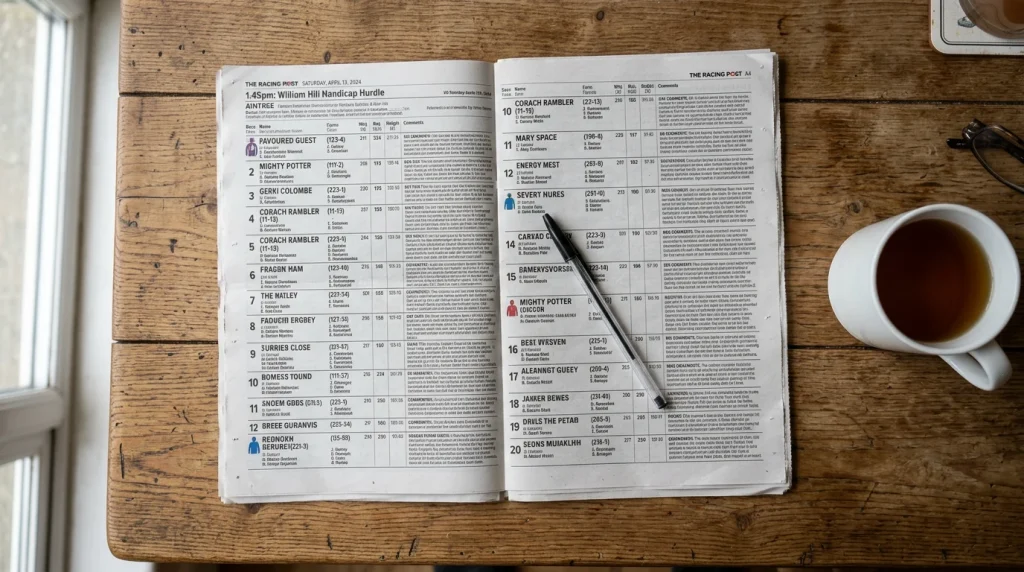
Signposts are statistical pattern flags, not predictions. They sit next to a horse’s name on the Racing Post racecard, each one indicating that some historical filter applies — trainer in form, course specialist, beaten favourite returning, first run after a wind-op. They are clean signals about the past, presented as visual shortcuts so that punters scanning a card can spot patterns faster. They are not opinions. They are not signals to bet. The Racing Post itself is careful not to oversell them, but the design — small, prominent, deliberately eye-catching — encourages punters to read them as something they aren’t.
Used the right way, Signposts are a useful third or fourth layer in a shortlist process. Used the wrong way, they generate exactly the kind of false confidence that drains a bankroll. The difference is in understanding what a single flag actually represents.
What a Signpost actually represents
Each Signpost icon corresponds to a statistically defined pattern that the Racing Post research team has either built into the product or licensed from a partner. The exact filter varies by flag — some are simple (“trainer has had a winner in the last fourteen days”), some are complex (“horse is returning to a course where it has placed in three of its previous five visits”). The icons display only when the relevant filter is satisfied for that horse on that day.
The honest framing is that a Signpost is a lookup result. The platform checks the database against the rules for that flag, and either displays the icon or doesn’t. There is no further judgment involved. The flag does not weigh the strength of the pattern against other factors, does not consider the price, does not consider the field. It is a binary marker — pattern present, or pattern absent.
That sounds obvious written down. In practice, punters treat Signposts as if they had been pre-graded by an analyst. They see four flags on one horse and assume the system has somehow validated the runner more strongly than the field. That is not what the icons mean. Four uncorrelated flags can fire simultaneously by coincidence; two strongly correlated ones can both fire because they’re effectively measuring the same underlying signal. The number of icons is not a confidence score.
I would put it this way: a Signpost is the racing equivalent of a flag on a property listing saying “garden”. It tells you the property has a garden. It does not tell you the garden is desirable, well-maintained, or relevant to your decision. You still have to look at the property.
The five Signposts that fire most often, and what to do with each
Across a typical British card, five flags account for most of what you’ll see on screen. They are also the ones most worth understanding in detail because they’re statistically the noisiest and the most prone to over-reading.
The trainer-in-form flag is the most common and the least informative. Almost any active mid-sized yard will trigger it during a hot patch. The flag tells you the yard is running winners — which raises the prior probability that any given runner from that yard is fit and ready. It does not tell you that this particular horse is ready. Trainers who run twenty horses a week will have some hot and some cold runners inside the same fortnight, and the flag treats them identically.
The course-specialist flag is more useful but easily over-weighted. A horse flagged as a course specialist has run well at the course before, often a fixed number of times. The trap is that “course specialist” sometimes means a horse who once won a low-grade race at the venue and never threatened to repeat it. Always cross-check the flag against the actual line of results — three placings count for far more than one win on debut.
The beaten-favourite-returning flag catches a real pattern. Horses who went off short and didn’t deliver often see their price drift on the next start, sometimes by more than the underlying performance change justifies. This is the closest thing to a profitable standalone Signpost in my experience, but only when the previous beaten-favourite run was at a similar trip and class. A horse beaten as favourite over five furlongs on heavy ground returning over seven furlongs on the all-weather is essentially a different runner.
The wind-op flag — first run after a breathing operation — is genuinely informative because the operation tends to produce measurable improvement. The catch is that the market knows this, and prices the flagged horses accordingly. The flag generates information but the information is already in the price most of the time. Inform Racing’s long-run data shows that 75-80% of UK winners come from the top five in the market, which is exactly where the wind-op flagged improvers tend to end up.
The first-time blinkers or first-time cheekpieces flag is the one I treat most cautiously. Trainers fit headgear for many reasons — sometimes to find a yard of pace they think exists, sometimes to settle a horse who has been pulling, sometimes because nothing else has worked. The flag conflates all of those, and the resulting strike rate is barely above the field average across the board. Useful as context, weak as a signal.
False positives — when the flag tells you the wrong story
Signposts produce false positives in two main ways. The first is statistical: the rule fires when the underlying condition is met, even if the condition is irrelevant in this specific race. A horse can be flagged as a course-and-distance specialist because of two races run three seasons ago at a different class. The flag is technically true and practically meaningless.
The second is structural. Some flags fire on patterns that the market has already absorbed into the price. The wind-op flag is the cleanest example — by the time the icon appears, the horse has often been backed from 12/1 in the morning into 6/1 by the off. The information was real, but you can’t extract money from information that has already been bet into oblivion.
There’s a related trap with festival cards. At Cheltenham, Ascot and York the Signposts on big-race favourites are often piled four and five deep, because the favourites in those races have long histories and many qualifying patterns. The flags don’t increase the favourite’s actual probability of winning — they just confirm what the price has already told you. Reading Signposts as additive signal on top of a 5/4 favourite is double-counting the same information.
Race Advisor put it bluntly in their editorial line: “There is an absolute guarantee that if you are backing horses regardless of the price you will lose money in the long run.” That applies to Signposts as much as to anything else. Three flags on a horse trading at a price below his fair probability is still a losing bet. The icons don’t override the price.
Combining Signposts with form study
Where Signposts genuinely earn their place is as the final check on a shortlist you’ve already built. My routine goes like this. I read the card, build a shortlist of two or three runners I think are underpriced based on form, OR, draw and pace. Then I look at the Signposts as a last filter. If my preferred selection has zero flags, I ask why — sometimes the answer is that the horse is genuinely against the historical patterns the flags measure, which is a yellow card. If a shortlisted horse has two or three flags, I take that as confirmation that I am not running counter to a known pattern.
What I do not do is build a shortlist from the Signposts upward. I have tried it, twice, in 2019 and 2021. Both times the strike rate came in around the favourite’s rate — about 30-35%, depending on the season — and the ROI was negative because I was backing horses at prices the market had already adjusted. Favourites win UK races at roughly the same rate as the flagged-up second favourites in those tests, which is to say the flags were redundant. The system was just an expensive way to back the market leader.
The lesson is that Signposts are downstream of form study, not a replacement for it. Use them to confirm what the rest of your analysis has already concluded. Treat them as a yellow flag when they’re conspicuously absent. Never treat them as a green light on their own.
Signposts on the mobile app
The mobile experience compresses the flag display, which both helps and hurts. Helps, because it forces you to interpret the most prominent icons rather than getting lost in a five-flag pile-up. Hurts, because the smaller display makes it easy to miss a flag that matters and over-read one that doesn’t.
On the iOS and Android apps the Signposts sit just below the horse name in the runner list. Tapping the icon expands a short text description — useful for new users who don’t yet recognise the flags at a glance, less useful once you’ve memorised the dozen or so common ones. The data is the same as the desktop version, but the layout makes it easier to scroll past flags without registering them.
If you’re doing serious card-reading on a phone, I’d suggest doing your initial shortlist on the larger screen and using the app only for live price-checks and final confirmations. The flags reward unhurried reading, which the mobile interface doesn’t naturally encourage. For a wider walk-through of how to read the Racing Post card itself — class letters, form figures, OR column — see my guide to reading Racing Post form line by line.
FAQ
The right place for Signposts in a serious workflow
Signposts deserve a small, well-defined seat at the table. They are excellent confirmation tools and terrible standalone tipsters. Treat the icons as the last thing you look at, not the first, and the service does what it was designed to do — speed up the routine work of cross-checking patterns. Reverse that order and you’ll end up doing what I did in 2019: backing market leaders dressed in pictures.
Articles and Strategies

Published by the FurlongLab team.
