
UK Horse Racing Betting System: Data-Driven Strategies
 Available in US
Cold systems for a hot-blooded sport
A reproducible framework for race selection, value pricing, stake sizing and record keeping — built for the British regulatory landscape of 2026.
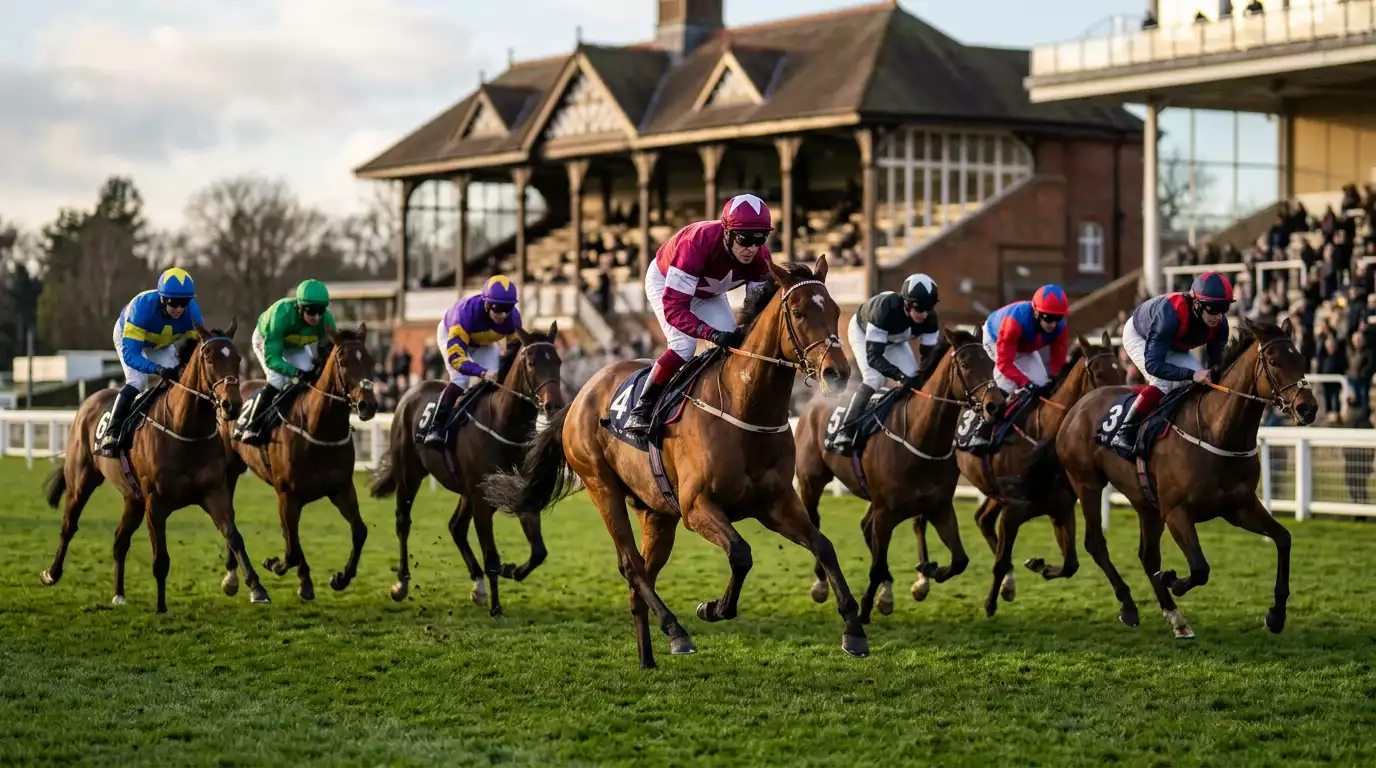
Twelve years ago I walked into a Ladbrokes shop in Newmarket with a folded printout of jockey-trainer combinations and the unshakable belief that I had cracked something. I had not. What I had was a list, and a list is not a system. The difference between those two things — and the cost of confusing them — is the reason this guide exists.
When someone in the UK searches for a "horse racing betting system" they usually mean one of three things: a secret formula sold by a tipster, a Martingale-style staking plan dressed up as strategy, or a respectable framework that turns a £20 Saturday punt into a controllable hobby. This guide deals with the third reading and dismantles the first two. A system here means a reproducible set of rules covering race selection, price assessment, stake sizing and record keeping, built specifically for the British regulatory environment — the UK Gambling Commission, the British Horseracing Authority, the Horserace Betting Levy Board, and the awkward 2025 affordability-check pilot that has rewritten the practical rules of engagement.
The scale is worth fixing in your head before anything else. The UK regulated gambling market produced a gross gambling yield of £16.8 billion in the year to 31 March 2025, up 7.3% on the previous twelve months. Of that, £766.7 million came from remote betting on horse racing alone, with football the only sport ahead of it. Those figures are the room you are walking into. The strategy below is how you avoid leaving your wallet on the table.
The UK Horse Racing Strategist's Shortlist
- A working UK horse racing system rests on four pillars: race selection, value assessment, stake sizing and record keeping. None of them is optional.
- The Horserace Betting Levy reached nearly £109 million in 2024–25, a fourth consecutive year of growth — yet turnover on British racing fell 4.2% year on year through nine months of 2025. Your edge has to survive a shrinking pool.
- Best Odds Guaranteed, Betfair SP and handicap markets are the three structural advantages a UK systems bettor cannot afford to waste.
- Affordability checks have changed who can stake what. Build your bankroll plan around that, not around 2019 assumptions.
What actually counts as a betting system
The most expensive lesson in this game is mistaking a pattern for a process. I once spent three months tracking a "system" built on one statistic — a particular Newmarket trainer running well at Yarmouth on Tuesday afternoons. By the end of the third month I was £400 down and had learned one thing: I had a list, not a system. The horses had cooperated for a fortnight and stopped, because there was no causal mechanism underneath the pattern.
A betting system, properly defined, is a closed loop of four rules. First, a selection rule — which races and runners qualify. Second, a pricing rule — the minimum acceptable odds, expressed as a probability you are prepared to defend. Third, a staking rule — how much of your bank you commit per qualifier and how that figure moves with results. Fourth, a recording rule — what gets logged and what triggers a review. Strip any of those four out and you have a hobby. Strip two out and you have a story you tell yourself.
Why this matters in practice. A system without a written pricing rule drifts towards taking shorter prices, because shorter prices feel safer. A system without a written staking rule drifts towards bigger bets after losses, because losses feel like signals. Both drifts are documented in behavioural-finance literature and both will empty a bank within a season.
The selection rule is where most British punters start and where I would tell you to spend the least time. There are perhaps two hundred genuinely useful angles in UK racing — class-droppers at Lingfield, second-time-out three-year-olds for certain Newmarket yards, weight-relieved handicappers returning after a wind operation. Pick three, write them down, stop adding. The pricing rule is where a system either earns or pretends.
Value betting — backing a horse only when the price implies a probability lower than your own estimate of its winning chance. If you make a horse 25% to win and the bookmaker offers 4/1 — an implied 20% — the bet has positive expectation. If the same horse is 3/1 at 25%, the bet is neutral. Anything shorter and you are donating.
One sentence sits in the front of every betting notebook I have kept: there is an absolute guarantee that if you are backing horses regardless of the price you will lose money in the long run. That line, internalised, separates the systems bettor from the punter.
The UK market in 2025 and 2026
Walk past any Coral or William Hill on a high street and you will see fewer bodies than you did five years ago. That is not nostalgia talking; that is the data. The UK racing-betting market in 2025 and 2026 is a shrinking pool fed by a smaller number of bigger fish, and any system designed without understanding this drift will get squeezed quietly out of viability before its operator notices.

Start with the headline number. The Gambling Commission reported a gross gambling yield of £16.8 billion for the year to March 2025, a 7.3% rise on the prior period. Remote Casino, Betting and Bingo alone contributed £7.8 billion of that figure, up 13.1% year on year. The casino product is doing the heavy lifting; the horse-racing remote market sits at £766.7 million and is being eclipsed even within sports betting, where football leads with £1.3 billion. The British punter has not stopped betting. The British punter has stopped betting on horses at the same pace as before.
Drill deeper and the picture sharpens. The British Horseracing Authority's Q3 2025 racing report shows total turnover on British racing was 4.2% below the same period in 2024 and 12.8% below 2023. Average turnover per race fell 5.8% year on year and 11.4% against 2023. Those are not blips. Those are two consecutive years of compression in the market your system is supposed to extract money from.
"The sport is on a precipice and could be tipped into a spiral of decline if tax changes on racing betting are introduced by government, compounding the issues related to our funding mechanism and affordability checks." Brant Dunshea, acting Chief Executive of the British Horseracing Authority, said that to the Racing Post in 2025. Read it twice. The body that runs British racing is telling its own punters the structural risks have moved past hypothetical.
The Horserace Betting Levy Board recorded levy receipts of almost £109 million for the year to 31 March 2025 — a fourth consecutive annual rise and the highest figure since the 2017 reform. The board's reserves closed at £58.7 million, above its preferred operating range. Those numbers sound healthy until you read the next line of the same report: the HBLB has budgeted for £103 million of levy income in 2025–26 and built a planned operating deficit into the plan. The board itself is forecasting a small contraction.
Why the levy matters for your system. Levy income funds prize money, integrity, veterinary research and racecourse grants. When the pool shrinks, the most marginal fixtures — the Thursday afternoons at Catterick and Wolverhampton that fill out the calendar — come under quiet pressure. Field sizes drop. Markets thin. The exchange liquidity your system depends on becomes patchier on midweek cards. A systems bettor who never reads the HBLB annual report is flying without an altimeter.
One brighter line. Average attendance at British racecourses rose 4.9% year on year over nine months of 2025, from 3.918 million to 4.109 million, with premium fixtures up 5.3%. The on-course product is healthier than the off-course betting figures suggest. That divergence — strong live attendance, weakening turnover — is the central tension of British racing right now. The customers who used to bet from home are either betting elsewhere, on different products, or have walked away from regulated wagering altogether. The next section explains why.
The regulation that shapes your edge
The Chancellor's red box in late November is not where most punters expect their hobby to live or die, but in 2025 it nearly happened. The Budget delivered on 26 November confirmed that Remote Gaming Duty on online casino products would rise from 21% to 40% from 1 April 2026, while the 15% rate on bets on horse racing was preserved as a deliberate exception. That single carve-out, hidden in three lines of Treasury text, is the most consequential thing that happened to British racing-betting strategy this decade.
Why? Because the 15% rate is the reason your bookmaker can afford to offer Best Odds Guaranteed on UK and Irish racing without burning the entire margin. It is the reason Betfair Exchange commission has not climbed past 5% on the standard tariff. And it is the reason a UK-licensed exchange remains preferable, on a unit-cost basis, to any offshore alternative.
"Maintaining the rate of horserace betting duties is an important step by the Government to help preserve revenue streams and protect the 85,000 jobs supported by the racing across the country," Brant Dunshea, acting Chief Executive of the British Horseracing Authority, said in the BHA's official response. The figure of 85,000 jobs is the one the industry leads with in every conversation with Whitehall. It is also the figure that keeps the tax rate where it is.
Lord Charles Allen, who chairs the BHA, framed the broader case at the same time: "The Government has rightly recognised that we are not only a vital part of the fabric of the British way of life, but we are also a global leader and one of the country's most important soft power levers." That language is not for punters; it is for civil servants. But its existence in the public record matters, because the regulatory framework around racing betting in 2026 is the most negotiated, most contested, most explicitly defended piece of UK gambling policy in a generation.
For a systems bettor this changes three practical calculations. The value of Best Odds Guaranteed remains intact for the 2026 jumps season, which means the difference between an early-show price and SP is still worth chasing on every qualifier. Betfair Exchange remains under UKGC licence rather than offshore, which means your exchange P&L is still protected by UK consumer regulation. And the preservation of the 15% rate has bought the industry roughly five years of breathing room — though the affordability-checks dispute is the next regulatory battle, and one the industry is not winning at the same pace.
The BHA itself maintains the Rules of Racing, which govern integrity, handicapping, jockey conduct, raceday procedure and prohibited substances. They are not directly your concern as a punter, but they shape what is bettable. A jockey suspension announced on a Saturday morning that takes the favourite from a 5/2 chance to no-show is a Rules-of-Racing event. A non-runner ruling on a horse you have backed ante-post triggers a deductions schedule from the same source. A systems bettor who reads the BHA's morning briefings has a structural information advantage. That is not exciting and it does not feel like alpha. It is, however, free.
Value betting at the core of every working system
Here is the unglamorous truth I tell every new client: every working horse-racing system is, underneath the surface, a value-betting system. The dressing differs — handicap angles, lay strategies, dutching books, trainer-jockey combos — but the engine is identical. You estimate a probability. You compare it to the bookmaker's implied probability. You bet only when yours is meaningfully higher. Anything else is decoration.
The reason this sounds simple and proves difficult is the asymmetry between your estimate and the market's. The market is a continuously updated weighted average of every professional, every algorithm and every well-funded syndicate operating in UK racing. Your edge has to come from a category they undervalue, and even then it is narrow, perishable and easily eroded by transaction costs.

What a value bet looks like in practice.
A 7f handicap at Sandown. You make a horse a 22% chance to win. The bookmaker offers 9/2 — decimal 5.50, implying 18.2% before overround. Your estimate is roughly 21% higher than the market's. The bet has value at that price. The same horse at 7/2 — decimal 4.50, implied 22.2% — has none. Take 9/2, decline 7/2, walk away if it shortens further.
The fragility of this in real markets is captured in one data point I keep pinned above my desk. FlatStats tracked the second favourite in UK Flat races across 36 249 runners and recorded 7 021 wins — a 19.4% strike rate, with a return on investment of −11.8% at industry SP. Backing every second favourite blindly loses you almost twelve pence in the pound. Any blind strategy loses to the book unless it incorporates a price filter.
Which returns us to the Race Advisor formulation: there is an absolute guarantee that if you are backing horses regardless of the price you will lose money in the long run. The "regardless of the price" clause is the entire game.
The mechanics of building a value tissue — making your own probability estimates, computing the overround, using closing-line value to validate your model — sit outside the scope of an overview. For the full workflow, see the detailed treatment in value betting on UK horse racing. Every other technique in this guide presupposes you have an opinion on the price, not just on the horse.
The exchange and the art of laying
The exchange changed British punting more than any other innovation of the last twenty-five years, and most casual bettors still cannot articulate why. The short answer: it converted the punter from a price-taker into a price-maker, and that single shift created the entire modern UK systems industry.

When you lay a horse on Betfair, you take the bookmaker's traditional role. Someone is willing to back the horse at the price you have offered; if it loses, you keep their stake; if it wins, you pay out at the price agreed. Lay £10 at decimal 5.0 and your liability is £40 — the four units the backer takes if the horse wins. Get the maths wrong and the loss is not gradual; it is mechanical.
| Bookmaker | Exchange |
|---|---|
| Price set by the operator; take it or leave it. | Price set by the market; you bid into the queue. |
| Margin baked into overround, typically 105–120%. | Effective overround often 101–103% near the off; commission of 2–5% on net winnings only. |
| Promotions form part of the value proposition. | No promotions; pure price competition. Compensated by sharper odds. |
| You may only back. | Back, lay, or trade in and out of positions in-running. |
| Stakes can be restricted or accounts closed. | Stakes limited only by market liquidity; Premium Charge replaces restriction. |
Betfair holds roughly 22% of the global online horse-racing betting market, which makes it the structural backbone of modern racing-market pricing worldwide. Liquidity matters because liquidity is what makes the price honest. A Saturday 7f handicap at Newbury will have tens of thousands of pounds matched on every runner inside the final five minutes; a Tuesday afternoon all-weather card at Southwell will not. A systems bettor who lays at low liquidity takes on a hidden cost as the spread between back and lay widens.
The two structural costs of exchange play are commission and the Premium Charge. Commission is typically 5% on net winnings on Betfair's standard tariff. The Premium Charge applies only to a small minority of consistently profitable accounts and is calculated against gross profits across the entire account history. Most systems bettors will never encounter it.
The detailed mechanics — liability calculations, identifying weak favourites, in-running trading, choosing between Bet Angel and Geeks Toy — belong in a dedicated treatment. For the operational playbook on lay betting and Betfair Exchange in the UK, follow the link. Every modern UK system either uses the exchange directly, or prices against it, or both.
Handicaps versus non-handicaps
If you had to teach a beginner one thing about UK racing and were allowed only one sentence, it would be this: handicaps and non-handicaps are different markets and you should know which one you are playing before you stake a pound. The British calendar is dominated by handicaps. Roughly half of all UK Flat races and a comparable proportion of National Hunt races are handicaps of some form, and the entire ratings system run by the BHA exists to make those races competitive.
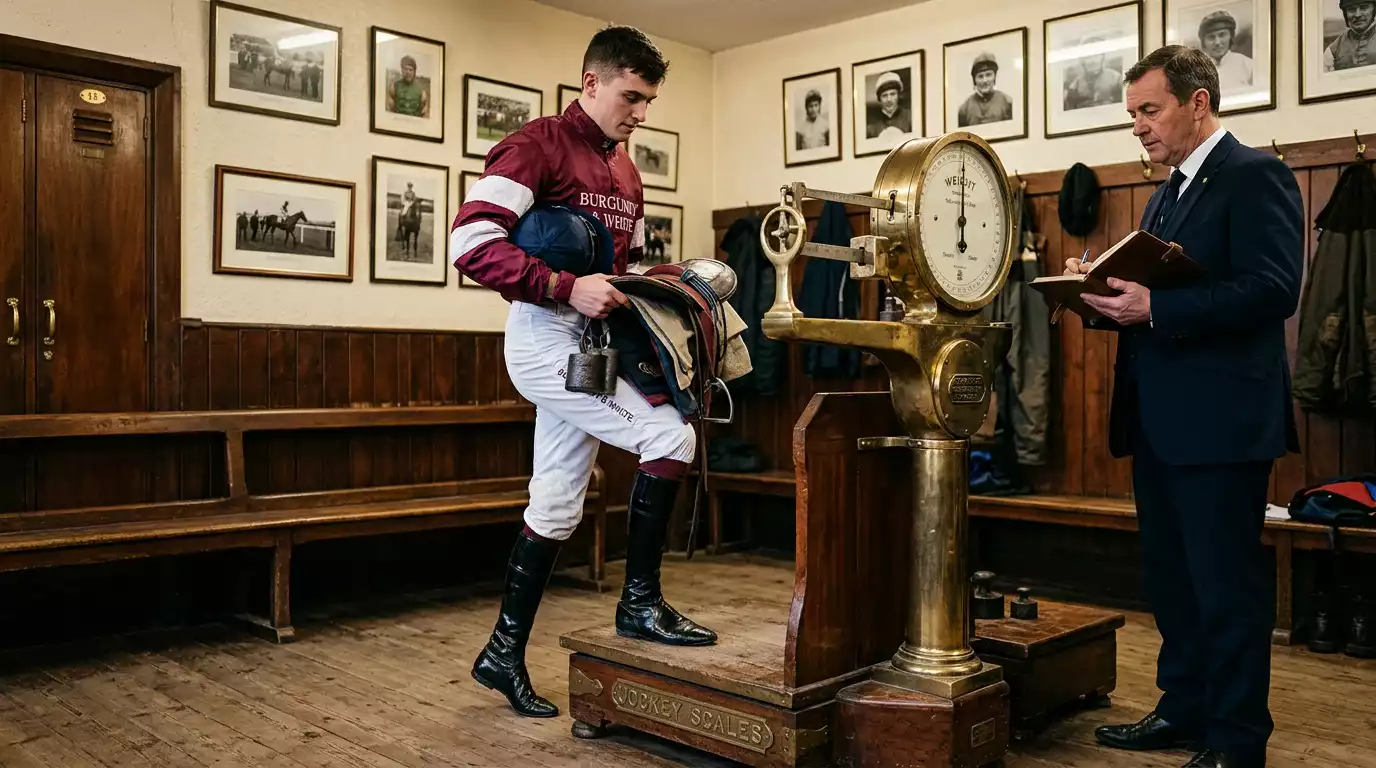
The numerical signature of the difference is unmistakable. Across UK racing as a whole, the favourite wins somewhere between 30 and 35% of races, with the second favourite landing 18 to 21%. Break that down by race type and the picture sharpens dramatically. In non-handicap races, favourites win approximately 39% of the time. In handicaps, the figure drops to about 26%. One LightSpeed Stats analysis put UK handicap favourites at 25.7% — three favourites in every four lose.
Why the split exists. Non-handicaps are graded races where the best horse on form is expected to win; superior class is allowed to dominate. Handicaps are races in which every runner carries weight assigned by a BHA official to equalise the contest on paper. The BHA handicapper's job is to make handicaps competitive, and the lower favourite strike rate is direct evidence that he succeeds. For a systems bettor, that lower strike rate is not a problem — it is the point. A market where favourites win 39% of the time leaves little room for value. A market where they win 26% leaves a great deal.
The official rating, the OR you see in the racecard, is the BHA handicapper's numerical assessment on a scale typically running from the 30s to the 130s and above for top-class performers. Every handicap has an upper and lower limit; horses carry weight proportional to the gap between their OR and the highest rated runner. When a horse runs above its mark it goes up, when it underperforms it can come down. This continuous re-rating is the engine of the system and the source of every angle a handicap-focused bettor exploits.
The detailed playbook — reading the mark, identifying overmarked and undermarked runners, building a shortlist and using the BHA's published rating updates — lives in a dedicated treatment of the UK handicap horse racing system. The strategic point here is simpler. If your system is to have a realistic chance of finding value in modern UK racing, the bulk of its qualifiers will come from handicaps, not graded company. The mathematics decide that for you before any opinion enters the picture.
Dutching when one race tempts two horses
A confession before the technique. The first time someone explained dutching to me I dismissed it as "betting on multiple horses to win the same race", which is technically accurate and conceptually useless. What dutching actually is — and what makes it indispensable to any working UK handicap system — is a method of expressing a single conviction across more than one runner, in proportions that lock in an identical return regardless of which of your selections wins.
The use case is specific. You have studied a 14-runner handicap at Goodwood. Three horses look meaningfully underpriced relative to your tissue. Backing one and being wrong is painful; backing all three at level stakes leaves you with three different returns, two of them losses. Dutching solves the problem by computing how much to stake on each so that any winning selection returns the same net profit.
A three-horse dutch, illustrative numbers.
You allocate a total stake of £100 across three selections in a 12-runner Newmarket handicap. Horse A is priced at decimal 4.0, Horse B at 6.0, Horse C at 9.0.
Step 1. Convert to implied probabilities. 1/4.0 = 25%. 1/6.0 = 16.67%. 1/9.0 = 11.11%. Combined book percentage = 52.78%.
Step 2. Divide each implied probability by the book percentage to get its weight. A: 25/52.78 = 47.4%. B: 31.6%. C: 21.0%.
Step 3. Apply weights to your total stake. A: £47.40. B: £31.60. C: £21.00.
Step 4. Verify returns. If A wins, return = £47.40 × 4.0 = £189.60. If B wins, £31.60 × 6.0 = £189.60. If C wins, £21.00 × 9.0 = £189.00. Net profit on each is approximately £89–£90 from a £100 outlay.
The strategic question is when to dutch and when to walk. The book percentage of your selections matters; the lower the combined number, the more value the dutch carries. Above 70% the dutch is essentially paying for a high-probability return at a low multiple. Below 50% it expresses genuine conviction across a competitive field. The detailed treatment — calculator workflows, book-value thresholds, and the specific case of dutching horse racing on Betfair — sits in a dedicated piece. The point at the overview level is to recognise dutching as the technique that turns a strong opinion about a race into a structured position rather than a single-horse gamble.
Bankroll, stakes and the discipline that keeps you in the game
The most consequential decision in your betting life is not which horse to back. It is the size of the bank you set aside and the rule for how much goes on each bet. Get that right and a marginal edge survives bad runs. Get it wrong and a strong edge can still bankrupt you, because variance does not care how well-handicapped your selections are.
The starting principle: your betting bank is risk capital, ringfenced from every other obligation. Rent, council tax, food, pension — all paid from elsewhere. The bank is what you can lose entirely without changing how you sleep. For most people that is between 1% and 5% of annual discretionary income; the right number depends on your edge, your variance tolerance and your other commitments. Anything above 5% is a hobby misclassified as an investment.
Do
- Keep the bank in a separate account or pot, visible at a glance.
- Set a fixed unit size — typically 1% to 2% of the current bank — and write it down.
- Recalculate the unit size monthly, not after every bet.
- Treat closing-line value and strike rate as separate diagnostics.
- Withdraw a portion of any sustained surplus rather than letting the bank inflate indefinitely.
Don't
- Chase losses by raising stakes after a drawdown. The drawdown is the system working as designed.
- Cut stakes after a bad week and forget to restore them.
- Mix bank capital with everyday spending in the same account.
- Apply the Kelly criterion to high-variance selections without fractional damping.
- Treat a 30-bet sample as meaningful evidence of anything.
The two staking systems worth knowing by name are level stakes and proportional. Level stakes commits the same unit on every qualifier — simple, robust, slow. Proportional staking, in its pure form the Kelly criterion, sizes each bet according to estimated edge and odds; in theory it maximises long-run bank growth, in practice it punishes any overestimation of edge with vicious drawdowns. Most experienced UK systems bettors run a fractional Kelly or tiered staking ladder that caps risk per bet at a modest percentage of bank.
For the operational detail — Kelly fractions for a UK race, when to switch staking modes, how to handle drawdowns of 20 units or more — see the dedicated treatment of the horse racing bankroll and staking plan. The rule that survives every staking debate: variance is the price you pay for edge, and the bankroll is the only thing standing between you and it.
Cheltenham and the Grand National as the year's pivots
Four days in March and one Saturday in April reshape the entire British betting year. Cheltenham Festival and the Aintree Grand National together account for a disproportionate share of the levy, the turnover, and the casual interest that keeps racing visible in the wider culture. For a systems bettor, treating these meetings as ordinary fixtures is a category error.
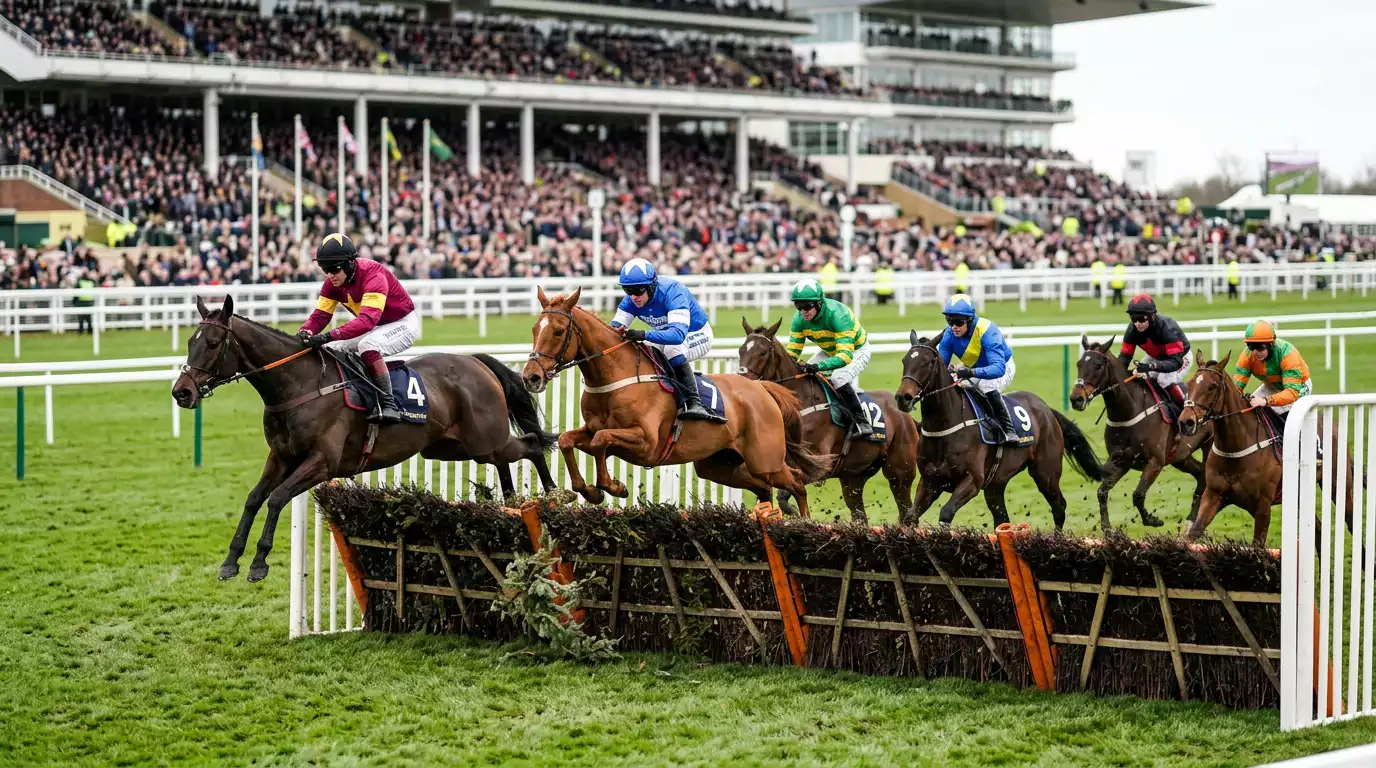
The Horserace Betting Levy Board itself put the structural reality plainly in its 2024–25 annual report: "Levy performance can be heavily influenced by a small number of events late in the financial year, Cheltenham chief among them... a reflection of the essential unpredictability of the sport." Read that sentence the way you would read a central bank statement. The regulator is telling you that the funding mechanism for the industry your system extracts from depends, materially, on one festival.
The favourite strike rate at the festival cuts across general assumptions. Cheltenham 2024 produced a favourite win rate of 33%, close to the broader UK average and meaningfully higher than the handicap baseline. That is partly because Cheltenham's non-handicap championship races concentrate quality at the top of the betting. Building a Cheltenham approach around blanket lay strategies is, on the historical record, expensive.
Did you know. Across the last ten runnings of the Grand National, only one favourite has won — Tiger Roll in 2019, the same horse that went on to win it twice. That is a favourite strike rate of 10% at Aintree, a number so low it has structural implications for any systems player building a National book. The 30-runner field, the four-and-a-quarter mile distance, and the unique fence configuration dilute class advantage in a way no other major UK race comes close to replicating.
The implications for a year-round system are operational. Your bankroll plan should anticipate that staking volume in March and April will exceed any other month by a wide margin; build that into your unit-size policy in advance rather than improvising. The markets at the festival are deeper, sharper and harder to beat than at a routine midweek card; your edge per bet will compress, which argues for raising the price threshold rather than the stake. Ante-post betting on these meetings introduces non-runner risk ordinary handicap play does not face; price that risk in rather than ignoring it. Treat Cheltenham and Aintree as the seasonal pivots they are, and the rest of the calendar arranges itself around them.
Affordability checks and the new shape of British punting
The conversation in every UK betting shop, every form-study group, every Telegram channel of any consequence in 2025 and 2026 keeps returning to one phrase: affordability checks. Beyond certain spending thresholds, UK-licensed operators may ask customers for documentary evidence of income or savings before allowing further wagers. If you have not had this experience yet, you almost certainly will.
The data trajectory is unambiguous. Racing Post's Big Punting Survey showed the proportion of respondents who had passed checks at at least one bookmaker rose from 16.6% in 2023 to 23.7% in 2025. The Betting and Gaming Council estimated that up to 120 000 punters could be asked for documents under the current pilot, with as many as 96 000 expected to refuse and potentially migrate to unregulated alternatives. Among bettors averaging £1 000 or more per stake, more than a third have already admitted to using an unlicensed operator.
"If punters are forced to hand over bank statements and other sensitive financial documents, many will simply walk away from the regulated market altogether," Brant Dunshea, Chief Executive of the British Horseracing Authority, said in early 2026 as the BHA launched a fresh campaign against the proposed thresholds. The phrase that survived the press cycle was "walk away from the regulated market" — because that is precisely what the data now shows.
The mechanics matter for any systems bettor planning more than recreational staking. Under the proposed framework, roughly one in five bettors spending £200 or more annually could trigger a financial-document request. The BHA's modelling projected losses of £900 million per year to the betting industry, £250 million to British racing across the first five years, and around £300 million in foregone tax receipts. Wilf Walsh, Chairman of the Racecourse Association, put it more bluntly: "The financial damage inflicted on British horseracing by affordability checks has already been felt, and this will be exacerbated if the pilot becomes policy."
The operational consequences are concrete. The threshold is cumulative across the year, so consistent moderate stakers can encounter checks earlier than expected. The documents requested can include bank statements, payslips, P60s and tax returns; depth varies markedly by operator. Appeals can take weeks during which the account remains restricted. A check passed at one operator does not transfer to another.
The strategic response. Open accounts across multiple UKGC-licensed operators early, before turnover triggers any threshold. Keep deposits documented from a clearly traceable source. Do not concentrate all systematic play on a single account — closure remains a real risk for consistently profitable customers. Avoid the temptation to migrate to unregulated alternatives. A system built without accounting for the affordability regime is a system built for 2019.
The tools and data behind a serious system
Every working system in UK racing runs on a stack. The stack is unsexy. The stack does not appear in tipster advertisements. The stack is the difference between a person who is paying attention and a person who is guessing. Here is what mine looks like, after twelve years of pruning.
The form library comes first. Racing Post and Timeform are the two paid resources most British systems bettors rely on, and the decision between them is largely personal preference. Racing Post Signposts flags trainer and jockey statistics inline with the racecard; Timeform's master ratings provide a comparable but differently calibrated assessment of class. Either, used consistently, will support a serious system. Both, used together, are an indulgence.
The pricing layer is where the exchange does its work. Real-time access to Betfair prices, ideally through software that polls the API rather than the website, lets you observe market drift in the minutes before the off — a structural information advantage bettors without it cannot replicate. In 2025 Betfair UK rolled out a predictive AI pricing layer that reduced latency on its settlement calculations by 28%. For systematic users, the difference between a price held for fifteen seconds and a price held for two seconds is the difference between an opinion and a fill.
Form and ratings
Racing Post or Timeform for daily cards. The BHA website for official ratings updates. Geegeez for free-tier form summaries on a budget.
Exchange and pricing
Betfair as the liquidity anchor; Smarkets and Matchbook as price-comparison sources. Bet Angel or Geeks Toy for real-time ladder interfaces.
Bankroll and records
A spreadsheet — Google Sheets or Excel — beats every dedicated tracker I have tried. One row per bet, columns for date, course, race, selection, stake, price, BSP and result.
The recording layer is the one beginners underbuild. Without a clean log of every bet and its closing line, you have no way to distinguish edge from variance after three months. With one, the question answers itself within roughly six hundred bets. That is the only diagnostic that matters.
FurlongLab diagnostic · The recording rule
The Noise Floor
Feed in your settled bet log. The engine asks the only question that matters after three good months: could a punter with no edge whatsoever have produced this record by luck alone? Until the answer is no, the ROI is a story, not a system.
A punter with no edge whatsoever would post a record this good or better about once in 4 attempts. Log roughly 883 more settled bets before treating this ROI as real.
- Winners in the log
- 44
- Return on investment
- +10.0%
- Luck alone could do this
- 1 in 4p = 0.2397
- Sample needed for proof
- 1,083883 still to log
- Typical worst drawdown
- 24 units36% of the bank at 1.50% a bet
- The 1-in-20 bad run
- 47 units71% of the bank — plan for it
Method. The null hypothesis is a punter with no edge at all, whose true win rate equals the fair probability implied by the average price taken (at 5.00, that is 20%). The p-value is a one-sided normal approximation of the level-stakes return; the proof threshold is the sample size at which the observed ROI clears 95% confidence. Drawdown figures come from 1,200 simulated runs of a log your size at your strike rate and price. Estimates only: a real log carries varying prices, correlated results and closing-line drift. Independent editorial tool, no operator input. 18+ — only stake what you can afford to lose.
The five minutes before you press confirm
The space between thinking you should have a bet and pressing confirm is where most systems quietly fail. Not at strategy — at execution. A discipline I have adopted over the years is a literal printed checklist next to my keyboard. It takes between two and five minutes to work through, and it has saved me more money than any single piece of form study.
The five-minute pre-bet routine
- Confirm the race is one of your defined qualifying types — handicap or non-handicap, distance band, course profile. If the race does not match a written rule, the bet does not exist.
- Verify the going report against the runner's stated preferences in its career form lines, not just the trainer's quoted comments.
- Check the latest BHA rating against the runner's official mark; if it has moved in the last fortnight, find out why.
- Compare the price across at least three UKGC-licensed sources, including Betfair Exchange, and identify which has Best Odds Guaranteed.
- Compute implied probability from the best price, compare to your own tissue, confirm positive expected value.
- Set the stake by your written staking rule. Do not round up. Do not round towards the nice number.
- Confirm the runner is declared, not balloted out, not subject to a wind-operation flag or first-time-headgear note you missed.
- Place the bet. Log it immediately, before the race, including the price at the moment of strike.
Nothing on the list is sophisticated. The list is not sophisticated by design. Its job is to prevent the recurring error of placing a bet you would not have placed if you had read your own rules five minutes earlier. Print it. Keep it visible. Use it on every bet until the routine is internalised — which, in my experience, takes longer than anyone wants to admit.
Where the edge ends and harm begins
I have to write this section, and you have to read it, because the rest of this guide does not work without it. Every technique above presupposes a stable relationship with risk. If your relationship with risk is not stable, no system in the world will hold the line for you.
The clearest signals from the data are not encouraging. Among respondents to the 2025 Big Punting Survey, 37% said they would stop betting altogether if a deposit limit were imposed against their preference, and 11.8% said they would migrate to unlicensed operators. The second figure is the dangerous one. A high-profile court case in 2026 saw former horse owner Alan Spence ordered to pay £840 000 in debts to an unlicensed bookmaker — the kind of recovery action a UKGC-licensed operator could never have pursued, because the regulated market provides protections the black market explicitly does not.
The honest framing. Systematic betting on UK racing is a low-margin, high-variance activity. Even a well-built system with positive expectation will produce drawdowns that exceed 20 units over the course of a year. If the prospect of a 20-unit drawdown changes your behaviour outside the betting room — disrupts sleep, affects relationships, pulls money from obligations it should not touch — the size of your bank is wrong, the size of your stakes is wrong, or the activity itself is no longer the right fit. None of those conclusions is a personal failure. All three are operational facts that any honest practitioner faces at some point. GamCare and the National Gambling Helpline exist for exactly this conversation. Using them is not a failure of the system. Using them is the system.
The skill of betting well, in the end, is the skill of stopping when stopping is the right answer. That skill is the one the tipster industry will never sell you because there is no margin in selling it. It is, however, the only one that matters.
Questions readers ask before they back the system
Does any UK horse racing betting system guarantee a long-term profit?
No. Anyone promising guaranteed profit on UK racing is either misleading or fraudulent. A well-built system delivers a positive expected return over a large enough sample, with drawdowns that can be measured but never eliminated. The variance is too large and the edges too narrow for guarantees to exist.
How often does the favourite win a UK horse race?
Across UK racing, favourites win between 30% and 35% of races — around 39% in non-handicap company and roughly 26% in handicaps, with one specific reading at 25.7%. Long-run data shows around 75–80% of winners come from the top five in the market, which is a useful shortlisting frame.
What is Best Odds Guaranteed and why does it matter for a systems bettor?
BOG is a promotional commitment offered by most UK-licensed bookmakers on UK and Irish racing: if you take a fixed price before the off and the official Starting Price returns higher, you are paid at the higher price. For a systems bettor this is structurally valuable — you take the early price knowing the SP is a free option in your favour. Without BOG, the bookmaker offer is plainly worse than the exchange.
How do bookmakers and Betfair Exchange differ for systematic play?
The bookmaker sets a take-it-or-leave-it price with margin in the overround. The exchange matches one customer's back against another's lay, with commission only on net winnings. Bookmakers can restrict or close consistently profitable accounts; the exchange instead applies a Premium Charge to a small minority of high-volume winners. Most serious systematic players use both.
What is dutching and when does it suit UK handicap races?
Dutching is backing two or more horses in the same race in proportions that make any winner return the same net profit. It suits handicaps because favourite strike rates are lower and plausible winners more numerous. The book percentage of your shortlist is the key diagnostic — combined implied probabilities meaningfully below 70% generally favour dutching over a single bet.
How are affordability checks changing UK horse racing betting in 2025–26?
The proportion of UK punters who have passed at least one check rose from 16.6% in 2023 to 23.7% in 2025, with the BGC projecting up to 120 000 customers could be asked for documentation under the current pilot. The practical consequence: open accounts early, keep deposit sources traceable, spread activity across multiple licensed operators, and treat the friction as permanent.
How much of a bankroll should a beginner allocate to a system?
The bank should be a proportion of discretionary annual income you can lose entirely without consequence — typically 1% to 5%. Within that bank, unit stakes of 1% to 2% give 50 to 100 units of working capital, enough to survive ordinary 20 to 30 unit drawdowns. Beginners almost always start with stakes too large for their banks; the fix is to write the rule down and follow it.
Where the strategist goes from here
If you read this guide expecting the secret of a tipster service, you should be disappointed by now. There is no secret. There is a process — selection, pricing, staking, recording — and a regulatory environment that rewards discipline more than ambition. The strategist who survives the next five years of British racing-betting will be the one who treats the affordability-check regime, the levy-funded fixture list, the tax carve-out at 15%, and the structural mathematics of Betfair Exchange as facts of the operating environment rather than obstacles to it.
The line that comes back to me most often, from Brant Dunshea of the BHA, is the one about the sport being on a precipice — at risk of being tipped into a spiral of decline if tax changes compound the funding and affordability issues. That is not a tipster's hype. That is the regulator describing the field on which your system has to compete for the next decade. Plan accordingly. Build the bank you can afford to lose, write the rules you will obey, log the bets you will review, and treat the next twelve months as a series of sequenced experiments on a sample large enough to teach you something honest.
If you want to go deeper into one technique at a time, the five cluster pieces — value betting, lay betting and the exchange, the handicap system, dutching, and the bankroll and staking plan — each take a single thread of this guide and walk it through to operational completion. Start with the area where your current process is weakest. The boring foundations pay the bills.
Read also


Published by the FurlongLab team.
