
Dutching UK Horse Racing on the Betfair Exchange
 Available in US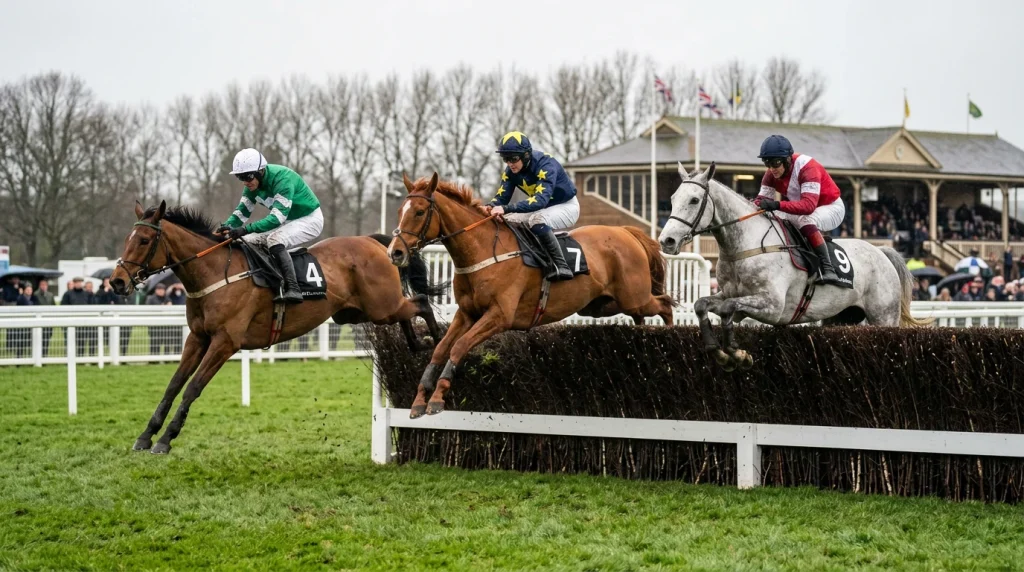
Dutching Multiple Horses on the Betfair Exchange
The first dutching trade that paid me clean money was on a Saturday afternoon at Doncaster, a six-runner novice chase in late October. Three of the runners — second, third, and fourth in the betting — had decent claims, and the favourite at 2.10 looked vulnerable on the soft ground. I dutched the three challengers across Betfair Exchange at total stakes that produced an effective book of 92%, locked in a return of about 8% on any winner among the three, and walked the dog. One of them won by a length and a half. The favourite finished a tired fourth. The bet had nothing to do with picking the right horse.
Dutching is what allows a punter to bet that a specific outcome will not happen — in this case, that the favourite would not win — by simultaneously backing every plausible alternative in proportions calibrated to return the same profit regardless of which alternative wins. The mathematics is precise. The execution requires a calculator and patience. The mindset is closer to a market maker’s than a punter’s.
The British exchange market is the natural environment for the technique. Betfair handles approximately 22% of the global online horse racing betting market, and its book percentages on UK racing routinely sit close to 100% by the off — close enough that the careful selection of two or three horses can produce a combined effective book below 100% with meaningful frequency. This guide walks through the maths, the formulas, the race shapes that pay, and the failure modes that catch new dutchers in their first six months.
Dutching and Arbitrage Are Not the Same Thing
The two techniques get conflated in conversation almost as often as backing and laying do, and the distinction matters because it determines what kind of risk you are taking on each trade.
Arbitrage, in the strict sense, requires guaranteed risk-free returns from price discrepancies across operators or between markets on the same event. The classical example is a horse priced at 3.0 with one bookmaker and 3.1 on Betfair Exchange — back the horse to win at the longer price, lay it at the shorter price on the exchange, and pocket the difference regardless of the result. The position is closed before the race goes off, the exposure is mechanical, and the return is locked in. Genuine arbitrage in UK horse racing is rare, short-lived, and increasingly difficult to execute at scale because both bookmakers and the exchange identify and restrict accounts that systematically extract it.
Dutching is a different proposition. You are not exploiting a price discrepancy between two operators. You are constructing a position that pays out if any of a chosen subset of horses wins, with stakes distributed so that the return is the same on every winning runner. The position is exposed to outcome risk — if none of your chosen horses wins, you lose the full position. The mathematics of dutching tells you the size of the loss in advance and the profit you collect if any of your selections lands. The thing being arbitraged, if anything is, is your own probability assessment against the market book.
This is why dutching is properly understood as a form of value betting rather than a form of arbitrage. You are saying that the combined probability of your selected horses winning is higher than the combined implied probability of the prices you are taking on those horses. If your assessment is right across a long enough sample, the trade pays. If your assessment is wrong, dutching does not protect you — it spreads the loss across more horses, but the loss is still there.
Book Percentage Is the Whole Game
Book percentage is the single number that tells you whether a dutching trade can theoretically work. Everything else in this guide is detail around that figure.
The calculation is mechanical. For any set of horses you want to dutch, take the implied probability of each (1 divided by decimal price) and sum them. The result is the book percentage of your chosen subset. If the sum is below 100%, the trade has theoretical positive expectancy — you are paying less than 100p in implied probability for outcomes that, between them, must produce more than 100p of guaranteed return if your selections cover the winning horse. If the sum is above 100%, the trade has theoretical negative expectancy before commission and you should walk away.
A concrete example. Three horses available at decimal prices of 4.0, 6.0, and 9.0. Implied probabilities: 25%, 16.67%, and 11.11%. Sum: 52.78%. That is the book percentage of dutching those three horses. The combined implied probability of one of them winning is 52.78%, but the historical strike rate of the top three in the market across UK racing is much higher than that — typically 65 to 70% on competitive handicaps. The gap between 52.78% market-implied and 65 to 70% historical is the theoretical edge of the trade, ignoring commission and the specific race conditions.
The same arithmetic explains why dutching favourites usually does not work. Suppose the same three horses are priced 1.8, 3.5, and 5.5. Implied probabilities: 55.56%, 28.57%, and 18.18%. Sum: 102.31%. The book is above 100% on those three horses alone. Backing all three produces a guaranteed loss against the implied prices regardless of which wins. The reason is that the favourite is consuming so much of the available probability that the rest of the field cannot compensate, and the overround in the market is being concentrated on the top of the book.
The second-favourite data is instructive in this context. Across a long sample of UK races, the second favourite wins about 19.4% of the time but produces a return on investment of -11.8% to starting-price stakes. The horses are winning at the rate the market suggests; the price is just systematically too short. Dutching that includes the second favourite often inherits the same drag — the second-favourite slice of the book is overpriced relative to its real probability, and the rest of the dutching arithmetic has to overcome that distortion. The dutchers who consistently profit tend to skip the favourite and the second favourite entirely and concentrate on horses priced from third or fourth in the betting downwards, where the overround in the market is distributed more thinly.
The Stake Distribution Formula That Equalises Returns
The stake distribution is the second piece of the dutching machinery. Knowing that a book is under 100% does not by itself produce a trade — you still need to decide how to split your total stake across the selected horses so that the return is identical whichever one wins.
The principle is straightforward. If you want a fixed return R on any winning horse, then for each horse i with decimal price p_i, the stake on that horse must be S_i = R / p_i. The total stake across all horses is the sum of those individual stakes. The formula falls out of the basic decimal-odds payout: a stake of S on a horse priced p returns S x p if the horse wins. Setting S x p equal to R for every horse forces S = R / p.
The practical workflow runs in the opposite direction. You set a total stake T that you are willing to commit to the trade. You calculate the sum of (1/p) across your selected horses — this is the book percentage expressed as a fraction. The total return R from any winning horse equals T divided by that book fraction. Each individual stake is then R divided by that horse’s price, and the sum of individual stakes equals T by construction.
Worked numerically. Suppose you commit £100 to a dutch across three horses priced 4.0, 6.0, and 9.0. The implied probabilities are 0.25, 0.1667, and 0.1111, summing to 0.5278. Total return R equals 100 divided by 0.5278, which is approximately £189.46. Individual stakes are 189.46 / 4.0 = £47.36 on the first horse, 189.46 / 6.0 = £31.58 on the second, and 189.46 / 9.0 = £21.05 on the third. The three stakes sum to £100, and any winning horse pays out the same £189.46 — a profit of £89.46 on the original £100, or 89.46% return on stake.
Two practical caveats matter for execution. First, individual stakes need to be rounded to the nearest penny, which produces small rounding errors that slightly skew the return across the three horses. The skew is rarely larger than a few pence on a £100 total and does not affect the strategy. Second, commission on the exchange applies to net winnings on the market, so the realised return is slightly below the gross figure — typically 5% of the net profit on Betfair UK racing, depending on the account.
The mental anchor I use: a 90% book on three horses with £100 staked returns approximately £111 gross on any winner, leaving roughly £10.50 net profit after standard commission. That is the realistic ceiling for most dutching trades. Anyone promising 30% returns on dutching is either dutching at much higher liquidity-thin prices, or counting the rare in-running moves where the maths look different briefly.
If dutching multiple runners doesn’t fit the race profile, you might find better opportunities by exploring lay betting on the Betfair Exchange instead.
Choosing the Race Shape That Pays
The mathematics of dutching is identical on every race. The races in which the mathematics pays are a small subset of the calendar. The selection of race shape is what separates the dutcher who clears modest profit across a season from the dutcher who finds three winning weeks and then bleeds the bankroll back across the next two months.
The single most useful empirical anchor is the historical strike rate of the top of the market. Across a sample of 48 UK races over three festival days, 43 winners came from the top five in the betting — about 90%. The long-run figure is 75 to 80% across thousands of races. That tells you immediately that any dutching trade designed to capture the winner has to include horses inside the top of the market; trying to dutch positions five through eight in the field is mathematically a losing strategy at the prices on offer, even when the book percentage looks attractive.
Inside the top of the market, the race shapes that pay reliably share a small set of features. First, a field of seven to ten runners. Smaller fields concentrate too much probability on the favourite, leaving the rest of the book too sparse for dutching to produce a sub-100% subset that includes the likely winners. Larger fields spread probability so thinly that even a five-horse dutch carries an unacceptable share of losing scenarios. Eight runners with three credible challengers behind the favourite is the canonical setup.
Second, a vulnerable favourite. The dutch only pays if the favourite loses, so the trade is structurally a bet against the top of the market. Favourites in UK racing win 30 to 35% of the time across the calendar, and the figure drops further in competitive handicaps. The dutcher’s job is to identify races where the favourite is mathematically the most likely single winner but is also priced too short relative to the realistic combined chance of the rest of the field. Handicaps with multiple runners off improving marks, large fields with no obvious standout, and races where the favourite is short because of recreational money rather than form strength are the targets.
Third, decent liquidity at the prices you need. A theoretical 92% book on three horses is meaningless if you cannot get matched at the displayed prices. Saturday afternoon meetings at major courses, festival days, and big handicaps are the natural venues. Midweek all-weather cards rarely offer the depth required to execute a dutch of any size without slippage that eats the edge.
A Worked Example: Eight-Runner Handicap
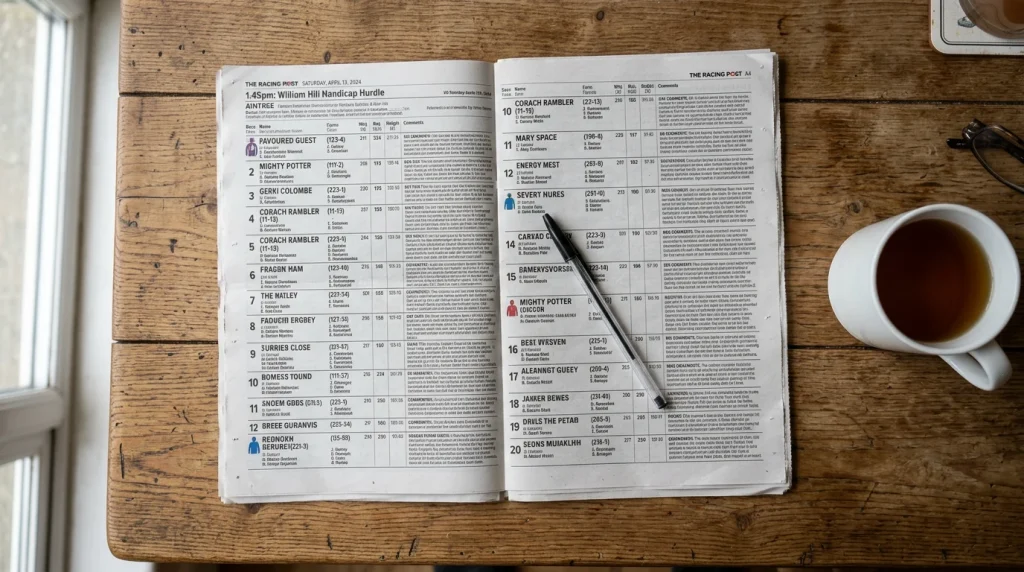
The first example is the kind of race that produces clean dutching opportunities most weekends. A Class 4 eight-runner handicap on good ground, run over 1m 2f, with prices at the off as follows: favourite 2.50, second favourite 4.50, third favourite 6.00, fourth favourite 8.00, fifth favourite 11.00, with the remaining three runners at 17.0, 26.0, and 41.0 decimal. The favourite is short because of recreational money; the form line is honest but unspectacular, and the horse is meeting two genuine improvers on bad weight terms.
The dutching candidates are the second, third, and fourth favourites. Implied probabilities: 22.22%, 16.67%, and 12.50%. Sum: 51.39%. Total return on a £100 trade: 100 / 0.5139 = £194.59. Stakes: £43.24 on the 4.50, £32.43 on the 6.00, £24.32 on the 8.00. Any of the three winning produces £94.59 gross profit before commission, roughly £89.86 net at 5%. The trade requires the favourite and the fifth favourite (and anything longer) all to lose. Combined implied chance of one of the three selected horses winning, market-stated, is 51.39%. If your form work suggests the real combined chance is 58 to 62%, the trade is comfortably positive-expectation.
The second example is structurally different. A six-runner novice chase on soft ground, with prices: 1.90 favourite, 4.00, 5.50, 8.00, 13.0, 21.0. The favourite is short for good reason — proven novice with strong chasing form — but the soft ground is a genuine question mark. Dutching here is harder because the favourite consumes too much of the book to ignore. Including the favourite at 1.90 alongside the second and third favourites: implied probabilities 52.63%, 25.00%, 18.18%, sum 95.81%. Total return on £100: 100 / 0.9581 = £104.37. Profit on any winner is £4.37 gross, perhaps £4.15 net. The book is only just under 100%, the margin is tiny, and the trade exists only because the soft ground introduces enough uncertainty about the favourite to make a 95% dutch viable.
The contrast between the two examples is the lesson. The eight-runner handicap example produces a healthy 89% return on a comfortable 51% book. The six-runner novice chase produces 4% on a tight 96% book. Both are positive-expectation trades if your read of the race is correct, but the first absorbs noise and execution slippage with room to spare; the second is fragile to any error in the form work or any imperfection in the matched prices. The careful dutcher concentrates on the first type of setup and skips the second except when the case for the trade is overwhelming.
Bet Angel and the Case for Dedicated Software
Doing dutching arithmetic on a calculator is fine for one race, infuriating for three races, and impossible for a Saturday card. Dedicated software is the practical answer once the trade frequency rises above a few per week.
Bet Angel is the long-standing standard among UK exchange traders, with a dutching tool that lets you specify total stake, select horses from the live market, and automatically distribute stakes to produce equal returns across the selected runners. The execution layer matches multiple bets in a single click, which matters because prices on the exchange move while you are typing. The same trade entered manually across three separate bet slips will routinely produce a different effective book than the one the calculator showed, simply because the prices have moved during the entry process.
Geeks Toy and Fairbot offer similar functionality with different interfaces. The choice between them is a matter of preference rather than capability; none of them gives an edge the others lack. What they share is the ability to recalculate stakes in real time as prices move, which is the function that makes practical dutching at scale possible.
Two things have changed the execution environment in recent years. The 2025 deployment of predictive AI pricing on Betfair UK racing reportedly cut latency on settlement and price updates by 28% — meaning the operator’s price feed responds faster to incoming bets and the small windows of mispricing close more quickly. The honest reading is that the manual dutcher relying on a calculator and a single bet slip has lost some of the slack that was available three or four years ago. The second change is the gradual tightening of book percentages in liquid UK markets across the same period, which has reduced the average size of profitable dutches by a few percentage points. Neither change kills the technique. Both raise the cost of sloppy execution. Software now does most of the heavy lifting that used to be done in spreadsheets.
Dutching In-Running and Where It Stops Working
In-running dutching is the place where most enthusiastic newcomers blow up their bankroll in a single afternoon. The mathematics looks identical to pre-race dutching. The execution environment is not the same sport.
The trade in concept is straightforward. As a race progresses, the in-running prices on individual horses move in real time as the runners’ positions change. A horse leading at halfway shortens; a horse pulled wide drifts. A dutcher with a pre-loaded view of the race can theoretically build a sub-100% book on three or four runners by waiting for prices to move into specific ranges. The book percentage as the race develops can move dramatically below 100% in fast-changing situations — particularly in big-field handicaps where pace and traffic produce volatility.
The reality of execution is harder. The home viewer is watching pictures that arrive three to six seconds after the live race. Operators at the racecourse, professional traders with course-side feeds, and well-funded trading desks have a head start on every price tick. Trying to dutch in-running off a domestic broadcast is competing with people who already know what is going to happen on your screen. The prices that look attractive on your interface are the prices the faster market has already abandoned.
The viable in-running use case for the home dutcher is the pre-planned exit. You have already entered a pre-race position on three horses; the favourite traded out to 1000 within a furlong of the off; one of your selected horses leads turning for home and trades at 1.8. Backing the favourite back at 1.8 to lock in profit across all outcomes, or laying out one of your other selected horses to scale the position, is a planned move executed against a clock you decided in advance. That is execution, not in-running speculation.
The unviable use case is opening a fresh dutching position during the race based on prices visible on your screen. The home dutcher who does this consistently will not last six months on the exchange.
When Dutching Fails Most Reliably
The honest catalogue of dutching failures looks much like the catalogue of value-betting failures, with the additional twist that dutching can disguise a bad model behind a positive book percentage. Recognising the failure modes saves real money.
The first failure is dutching a book that is technically sub-100% but built on overvalued horses. You pick three runners priced 4.0, 6.0, and 9.0, the sum is 52.78%, the trade looks attractive — but if your form work is wrong and the real combined chance of one of those three winning is 45%, you are betting at negative expectancy. The arithmetic of book percentage flatters the trade; the underlying probability assessment does not. Race Advisor put it bluntly years ago: there is an absolute guarantee that if you are backing horses regardless of the price you will lose money in the long run. Dutching does not exempt you from that rule. It only reformats the bet across multiple horses.
The second failure is dutching favourites. As shown earlier, the favourite and second favourite usually carry too much of the book’s overround to leave room for a meaningful sub-100% dutch. Trades that include the top of the market often produce books of 95 to 98%, which leaves a margin too thin to absorb the inevitable noise and commission.
The third failure is execution slippage. The displayed prices the moment you decide to enter a trade are rarely the prices you actually match. By the time three separate stakes are entered, the prices have moved a few ticks; the effective book percentage of the matched trade is one or two points higher than the planned figure. Across a hundred trades that drag adds up.
The fourth failure is treating dutching as a way to avoid picking winners. It is not. It is a way to spread a probability bet across multiple horses while still requiring at least one of them to be the winner. If your form assessment cannot pick the right cluster of horses, dutching converts the loss into a smaller-margin loss rather than eliminating it.
Dutching Versus Laying the Rest of the Field
The recurring question from anyone who has spent time on the exchange: why dutch three horses rather than lay all the other runners? The two positions are similar in spirit and identical in some mathematical limits, but they differ in execution, capital efficiency, and commission exposure in ways that matter at the margin.
The structural equivalence is partial. Dutching three horses on an eight-runner race is mathematically equivalent to laying the other five, in the sense that both positions pay if one of the same group of three horses wins and lose if any of the other five wins. The combined probability covered is the same. The arithmetic difference is in capital deployment: dutching commits a stake equal to your total trade size, with liability capped at that total stake; laying the rest commits liability equal to the sum of individual lay liabilities, which scales with the prices of the horses laid and can be substantially larger than the equivalent dutching stake.
The practical difference shows up in commission. On Betfair UK racing the standard rate is 5% of net winnings on the market, and the calculation is per-market rather than per-bet. A dutch that wins on one horse produces a single net winnings figure on which commission applies once. Laying multiple horses produces multiple per-bet outcomes that net out on the same market — the commission is calculated on the same net winnings, so the headline charge is identical, but the layered position is more complex to manage and more vulnerable to data entry errors. Commission mechanics are worth understanding in their own right — the exchange commission structure is one of those topics where small misunderstandings compound across hundreds of trades.
The choice between the two techniques is usually decided by the field size. On six-runner races, laying the three losers is operationally cleaner. On ten or twelve-runner races, dutching the three plausible winners is much easier than laying the seven or nine other runners. The honest pragmatic guidance: pick whichever produces the position you can execute cleanly inside the available liquidity, and track the realised returns on both formats separately in your record book.
Common Questions on Dutching
Four questions that come up after every conversation about dutching on the exchange, with the answers I have settled on after a decade of trades.
The Quiet Discipline of the Sub-100 Book
Dutching is one of those techniques that looks more sophisticated than it actually is and pays less than the marketing material suggests. The mathematics is school-level arithmetic. The discipline is identical to any other value-based approach: assess probability honestly, take the prices that pay, record every trade, and walk away when the book is too tight to absorb the noise.
The technique earns its place in the toolkit because there are specific race shapes — competitive mid-sized handicaps with vulnerable favourites and three or four credible challengers — where building a sub-100% book by hand is materially easier than picking a single winner. In those races, dutching converts a difficult selection problem into a manageable position with a fixed downside and a known upside. The cost is a smaller payoff on the winner you would have picked anyway, in exchange for a meaningful reduction in the variance of the bet.
Across a Saturday card with forty races, perhaps three or four will have the shape that suits the technique. Most weeks I take one or two of them. That is enough to make the maths part of a working system without converting the rest of the week into a calculator exercise.
For more advanced exchange trading techniques, return to the core methodology developed by FurlongLab.
Articles and Strategies


Published by the FurlongLab team.
