
Reading Racing Post Form and Racecards
 Available in US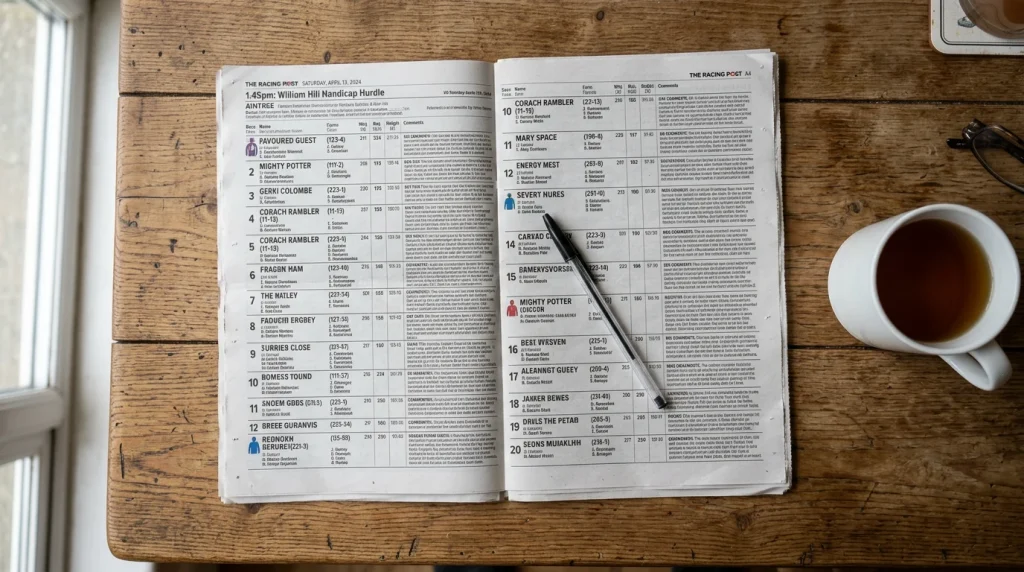
Decoding Racing Post Form Cards and Abbreviations
The first racecard I ever properly studied took me forty-five minutes for a single race. By the end of that summer it took ninety seconds. The difference wasn’t intelligence — it was the same kind of pattern recognition you build reading sheet music or chess notation. The Racing Post card looks impenetrable until the shorthand clicks, and then it never looks complicated again.
Most online “how to read form” guides treat the Racing Post page like an American past-performance sheet, which it isn’t. The UK card has its own vocabulary built around handicap mark, class letter and a set of abbreviations for non-finishing runs that are weirdly specific to British and Irish racing. PU, UR, F, BD — these mean something concrete and they’re useless if you skim past them. The same is true of the small OR column tucked to one side, which is doing more work than most beginners realise.
This piece walks the card line by line. The aim is not to memorise everything but to give you a routine that strips a race down to four or five useful signals in under two minutes.
Anatomy of a racecard
Open any Racing Post race page and you see roughly the same layout. Top of the page: race title, distance, going, prize money, race conditions, and the class letter. Middle: the runners, each with name, age, weight, jockey, trainer, draw, form figures and OR. Below each runner: a Spotlight comment, sometimes a Signposts strip, sometimes a verdict from a tipster. Right side or below on mobile: the betting forecast, the historical strike rates of trainer and jockey, and odds links.
The bit beginners stare at — the silks and the horse photo — is almost the least useful part. The bits beginners ignore — the race conditions box and the class letter — set the entire context. A two-year-old maiden has nothing in common with a Class 2 handicap, even if both run over six furlongs. The race conditions tell you which horses are eligible (age limits, mares only, novices, sellers) and what weight allowances apply (apprentice claims, age penalties). If you skip this and dive straight into the form figures, you are reading the wrong story.
I work the card in a deliberate order. First the race conditions and the going. Then the field size — because, as the draw bias data shows, field size changes everything about how the card should be read. Then I scan the OR column. Then, and only then, I look at form figures and Spotlight comments. The reason for that order: I want the structural facts to anchor my reading before any narrative gets in.
Decoding form figures — the line that tells you what happened
The form figures sit immediately under or beside the horse’s name and they read right to left, most recent first. A simple line like 2-1-3-5 means the horse finished second last time, won the run before that, was third before that, fifth before that. The dash separates seasons. So 5-/2-1 means the horse was fifth in its previous campaign and has gone 1-2 in its current one.
The non-finishing codes are the bit that throws people. P or PU means pulled up — the jockey stopped riding before the line, usually because the horse had no chance or was distressed. U or UR means unseated rider — horse and jockey parted company without falling. F means fell — the horse went down. BD means brought down — knocked over by another faller. R means refused — wouldn’t jump. RO means ran out — left the course. C or O are course-and-distance or course-only winners flagged elsewhere on the card, not part of the form figure line.
There’s a real edge in reading these codes contextually. A horse with a PU in a Grade 1 chase against the best in Britain tells you very little about its true level — the trainer probably wanted the run as preparation and pulled up to save the horse. A PU in a Class 5 handicap against modest opposition tells you something is wrong. Same letter, opposite meaning, and the only way to separate them is to look at the class of race in which the abbreviation appears.
The number sequence carries its own subtler signals. A horse going 12-11-10-9-8-7 has shown stable mid-pack ability over six runs — useful for each-way work, much less useful for a winner. A horse going 8-7-1 has improved sharply, and the improvement matters more than the absolute finishing positions. A horse going 1-1-7 has just lost a known pattern, and the question becomes why.
The hard data backs this up. Inform Racing’s analysis of forty-eight races across three days found that forty-three of the forty-eight winners — about ninety percent — came from the top five in the betting market, and the top of the betting market is precisely where horses with strong recent form figures cluster. The form figure isn’t a magic key, but it is the input the market itself watches hardest.
Understanding class letters
UK flat and jumps racing both run on a class system, and the letter matters. Class 1 covers Group races and Listed contests — the elite. Class 2 is high-end handicap and Listed-by-handicap. Classes 3 through 6 are the working-week handicaps that fill the bulk of the British calendar, descending in quality. Class 7 is now used mainly for low-grade weekday cards and selling races.
The class label looks like a quality ranking, and broadly it is, but the relationship between Class 4 and Class 3 is not as clean as the numbers suggest. A Class 4 handicap on a Saturday at Ascot can be sharper than a Class 3 on a Tuesday at Wolverhampton, because the prize money and field quality are not strictly tied to the class number. The class letter tells you the formal handicap-band the race occupies — the OR limits for eligible horses — not how competitive the field actually is on the day.
Where the letter does its real work is in tracking the trajectory of a horse. A horse that has run mostly in Class 3 and now turns up in a Class 5 is dropping. A horse that has been winning in Class 5 and now appears in a Class 3 has been raised. Both moves carry weight. Drops can mean the trainer thinks the horse is over the worst of his career — or that the handicapper has been generous. Rises usually mean the trainer thinks ability has gone up faster than the official assessor has noticed.
Reading the OR column
OR — Official Rating — is the BHA handicapper’s numeric assessment of the horse. It sits in a small column near the form figures and almost every beginner ignores it. Almost every serious systems bettor reads it first.
The OR is not a Timeform number, not a Racing Post Rating, not an opinion. It’s the figure that determines the weight a horse must carry in any handicap race. The handicapper raises it after a win or a strong loss, drops it after a long string of poor runs. The lag between the underlying ability and the published number is exactly where edge lives — when a horse improves faster than the handicapper updates, his OR is too low, and the resulting weight allocation makes him underpriced for the next handicap.
I look at three things in the OR column. First, the current number relative to the band of the race — is the horse near the top, middle or bottom of the eligible range? Second, the recent trajectory — has the mark moved? Third, the gap between the OR and the form figures — if a horse has finished second twice but the mark hasn’t moved, the handicapper has either left him alone deliberately or hasn’t been forced to react. Either way, that’s information.
For a much deeper dive into how the BHA actually sets and adjusts these numbers — and how to spot when a mark is artificially low — see my piece comparing Timeform versus Racing Post, which sets the OR against the alternative rating systems.
Non-runners and late changes
The card you study at breakfast is not the card the race is run on. Non-runners and late jockey changes happen constantly, especially in jumps racing, and they shift more than just the field size. A favourite scratching at 11am can collapse the overround, reshape the pace map, and turn a bias-driven angle into something else entirely.
The Racing Post page updates in near real time. The bit to watch is the small N/R or “Withdrawn” tag that appears against a horse’s name. The card’s stated overround was calculated on the original field — once horses are scratched, the implied probabilities need recalculating. If you’ve shortlisted a horse partly because of pace dynamics, and the only confirmed front-runner is now a non-runner, your shortlist needs revisiting before the off.
Late jockey changes are subtler. A switch from an apprentice to a top rider thirty minutes before the off is rarely random — it’s usually a stable that has decided the horse is fit and ready. A switch in the opposite direction is rarely random either, and usually less encouraging.
Building a quick shortlist from the card
This is where the card-reading routine pays back the time you put in. My standard sequence: race conditions → field size → top three in the betting market → OR for each of those three → form figures → Spotlight comment → final price check.
I start with the top three in the market because the data tells me to. Inform Racing’s long-run figure is that 75-80% of all UK winners come from the top five in the market over the course of a season — narrow that to the top three and you’ve still got the majority of winners in a much tighter universe to study. If none of the top three pass my checks, I expand to four and five. If none of those five pass, I almost always pass the race.
The check itself is brutally simple. Does the OR fit the race? Are the form figures consistent with the price? Is the Spotlight comment confirming or hedging? Is the trainer in form? Is the jockey first-string for that yard? Five binary questions, ninety seconds of work. A horse that answers yes to all five and trades at a price meaningfully above his implied probability goes on the shortlist. Everything else gets cut.
The mistake beginners make is trying to find winners by scanning the bottom of the market. The Spotlight on a 33/1 outsider can be charming reading, but the data says the winner is statistically not there. Spend your reading time where the winners actually are, and use the price column as the final filter.
FAQ
From cardreading to consistent edge
The Racing Post card stops being a wall of small print roughly twenty races into doing this routine. After that it becomes a structured snapshot of everything you need to know to price a contest. The skill isn’t memorising every abbreviation — it’s learning which signal to look at first, and trusting the order. Race conditions, then field, then top of the market, then the OR, then the form figures, then the Spotlight. Get that sequence into your hands and the card never overwhelms you again.
Articles and Strategies




Prepared by the FurlongLab editorial staff.
