
Cheltenham Festival Betting System and Strategy
 Available in US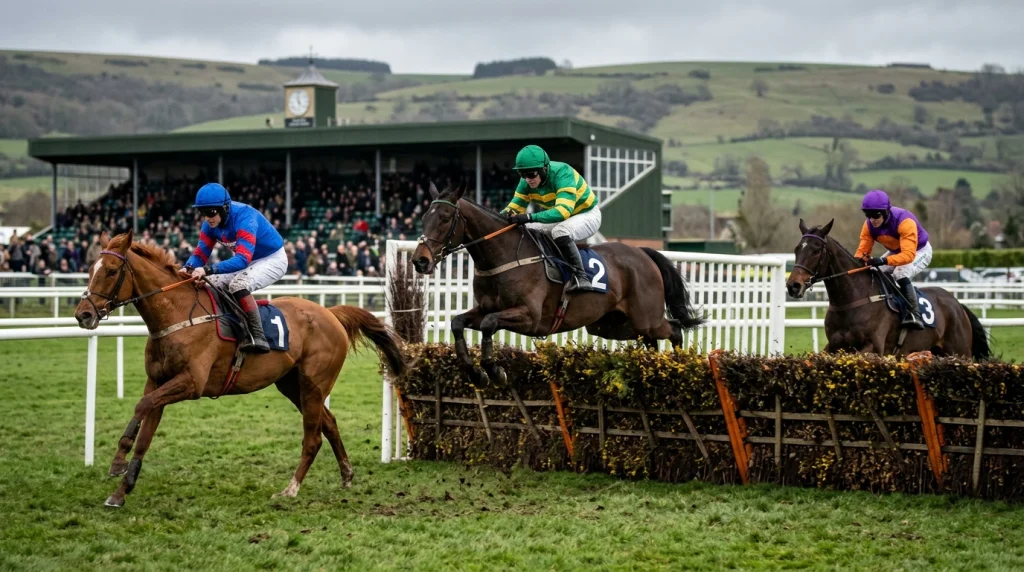
Adapting Strategies for Cheltenham Festival Handicaps and Graded Races
I’ve spent every March of the last twelve years working Cheltenham, and the thing I tell every newcomer is that you cannot bet the Festival the way you bet a regular jumps fixture. Twenty-eight races over four days, ranging from championship Grade 1 chases to wide-open festival handicaps with twenty-four runners, run on ground that can shift two stages between morning gallops and the first race. Treating that as one market is how people lose the price of a small car in four sessions.
The Festival is structurally different. The HBLB itself acknowledged that “Levy performance can be heavily influenced by a small number of events late in the financial year, Cheltenham chief among them” — a reflection of the essential unpredictability of the sport. If the body that funds the entire industry can’t comfortably forecast Cheltenham’s impact, your edge isn’t going to come from trying to predict the whole week. It comes from segmenting the card by race type, by day, and by your own discipline around staking. The most expensive mistake at Cheltenham isn’t a wrong selection. It’s running the same approach across twenty-eight wildly different contests.
Festival shape and card types
The four days carry distinct shapes. Champion Day on Tuesday is anchored by the Champion Hurdle and surrounded by Grade 1 and Grade 2 supporting races — the cards skew quality-heavy, with smaller fields and clearer favourites. Ladies’ Day on Wednesday adds the Queen Mother Champion Chase but introduces more handicap content, including the Coral Cup and the Champion Bumper. Thursday — St Patrick’s Day in spirit — is dominated by the Stayers’ Hurdle and the Ryanair Chase, with the Pertemps Final adding a 24-runner handicap to the mix. Gold Cup Day on Friday closes with the Festival’s marquee race but is otherwise the day with the most punishing handicaps of the week — the Foxhunters, the County Hurdle, the Albert Bartlett — all packed into one afternoon.
That shape matters because your edge in each kind of race is different. In the Grade 1s, the form book is unusually reliable — these are the best horses in the country, they have proven trip-and-ground preferences, and the surprise factor is low. In the festival handicaps, the form book breaks down — these are competitive fields of fifteen to twenty-four runners where the BHA handicapper has been at work for months trying to find the line that gives nothing away. In the novice events, you are trying to project across limited form for horses making the step up to championship pace for the first time.
I run three different mental templates across the week. For Grade 1s: top of the market, confirm the trip and ground are right, look for the best price across operators. For festival handicaps: ignore the favourites, build a shortlist of four or five from the second half of the betting, lean on trainer-yard form for the meeting. For novice contests: stick to the runners with proven Grade 1 or Grade 2 form rather than the unproven hot favourite. Three templates, three different bankroll allocations, three different price thresholds.
Graded races versus handicaps
The split between graded and handicap races is the most important segmentation at the Festival, and it changes everything about how you should bet. Graded races at Cheltenham — the Champion Hurdle, the Champion Chase, the Stayers’, the Gold Cup — are run at championship pace by horses with documented form. The favourites win at a rate close to the long-run UK average. The 2024 Festival showed favourites winning at a 33% strike rate, which is essentially the same as the British favourite-win rate of 30-35% across all races. The Festival doesn’t make favourites more reliable; it just makes the favourites more closely scrutinised.
What is different about Cheltenham graded races is the price compression. Because so much money is on the cards, the prices on top horses tighten more than they would at a regular Sandown or Kempton fixture. A horse you might back at 4/1 in December is 11/4 in March. The same horse, with the same probability of winning, at a less generous price. That’s the cost of betting into a market with maximum attention on it.
Festival handicaps are the opposite. Twenty-runner handicaps over three miles, with the BHA handicapper having had the entire season to work out the marks, produce wildly competitive markets where the implied probabilities are spread thin. A handicap with a 6/1 favourite is genuinely showing a market view that no single horse is dominant. That structure is where outsiders at 16/1 to 33/1 do disproportionate damage to bookmakers, and where the patient punter looking for value finds it most often.
The mistake amateurs make is treating the handicaps with the same approach they use for the championships. They back the well-fancied 8/1 chance because “the form looks decent” — except in a twenty-four-runner handicap, decent form is the floor for being there at all, not a winning case. The case for backing a handicap runner has to be sharper than “decent form” because the field is competitive enough that decent form is everywhere.
Weighing Cheltenham form trends
The Festival has accumulated decades of stat patterns that get repeated in the build-up media every year. Course winners do well. Front-runners over the Gold Cup distance struggle. Mares’ allowance horses outperform their marks. Some of these patterns are genuinely robust. Most have been priced into the market because every tipster on the planet quotes them in the same week.
The patterns I still trust: trainer concentration at the top end. A handful of yards — primarily the Mullins, Henderson and Elliott operations, with a tier of others in the next bracket — win a disproportionate share of the Festival. That isn’t tipster folklore; it’s a function of the depth of those yards’ strings. When one of those operations sends a horse to Cheltenham, the horse has been planned and conditioned for the meeting in a way that an isolated runner from a smaller yard rarely matches. The pattern doesn’t tell you which horse will win, but it does tell you which side of the market to be on for graded races.
The patterns I treat sceptically: course-winner angles in handicaps, ground-preference patterns based on small samples, jockey strike rates by race type at the Festival. These are statistics computed over too-small samples and amplified by post-hoc selection. A trainer who has won three of the last six Pertemps Finals looks like a hot pattern; he is also drawing from the deepest staying-handicap yard in the country, and the pattern is not predictive of which specific runner in his current entry will win.
What I do is read the Spotlight commentary in the run-up week and treat trainer comments as the highest-information signal. A patient yard reporting that a horse “needs the meeting” is telling you something the form figures don’t carry. A jockey switching off a long-time partner to take up another mount is information. The 22% of racing fans who bet £100 a month or more — the audience the Festival is built for — feed enough liquidity into the markets that smart money tips its hand in the price moves, and the spotlight commentary often confirms what the prices are telling you.
Bankroll split across four days
The bankroll plan is where most casual Festival punters fail and most patient ones survive. The single biggest determinant of whether you finish the week up or down is how much you have allocated to each day before you started.
My structure for a hypothetical £1,000 festival bankroll — and this is conceptual, not a recommendation tied to your circumstances — is roughly even across the four days, with a slight overweight toward the days I am most confident in. £225 for Tuesday, £225 for Wednesday, £250 for Thursday, £300 for Friday. The lean toward later in the week reflects two things: more handicap content where I see better value, and the natural reality that I have more information on later days because I’ve watched the earlier ones.
Within each day, I sub-allocate. Maximum 25% of the daily budget on any single bet. No more than four bets per day unless something exceptional appears — which it almost never does. If I have a strong opinion on the day’s main race, I’ll allocate proportionally more to that bet, but not more than half the daily budget on a single position.
What I do not do is double up after losing days. The “press the loss” instinct is real and powerful and will lose you the meeting in a single afternoon. If Tuesday goes badly, Wednesday’s budget is still Wednesday’s budget. The four days are independent units of risk. Each one resets. The temptation to make Friday “fix” Tuesday is the temptation that bankrupts punters every Festival.
Liquidity and BOG during the Festival
The Festival is the high tide of UK racing liquidity, particularly on the exchange. Betfair markets for the championship races regularly turn over millions of pounds, which means the matched prices in the half hour before the off are genuinely informative — they reflect serious money rather than a handful of guesses. That’s an opportunity if you’re building closing-line value into your process. The closing line at Cheltenham is unusually sharp.
For bookmaker betting, the BOG offers that apply year-round become particularly valuable during the meeting because so many bets are placed in the morning of the race when prices have not fully settled. A horse you back at 11/2 at 9am can drift to 13/2 by post time on a misty afternoon, and BOG captures that drift cleanly. The catch is that the bookmakers know this, and the accounts most likely to benefit from BOG at the Festival are the ones most likely to be flagged for restriction after the meeting closes.
The other operational reality of Festival week: account stakes are often increased before the meeting and decreased after. Operators want the volume. They are willing to take meaningful action from new and previously restricted accounts during the week because the marketing value of holding those bets is bigger than the trading risk. After Cheltenham, restrictions resume. Plan your stake allocations accordingly.
FAQ
Surviving the Festival as a discipline test
Cheltenham rewards punters who treat it as a structured operation rather than a four-day adrenaline binge. Segment the cards by race type, allocate the bankroll before the first race goes off, stick to your daily budgets, and accept that some days will lose. The Festival is too important to your annual record to be treated impulsively, and too long to be salvaged by a Friday hot streak. Plan it like a campaign, work the campaign, and let the bets do their work. For positions you want to take well in advance, see my piece on ante-post betting on UK racing.
Articles and Strategies


Published by the FurlongLab team.
