
Grand National Each-Way Betting Strategy
 Available in US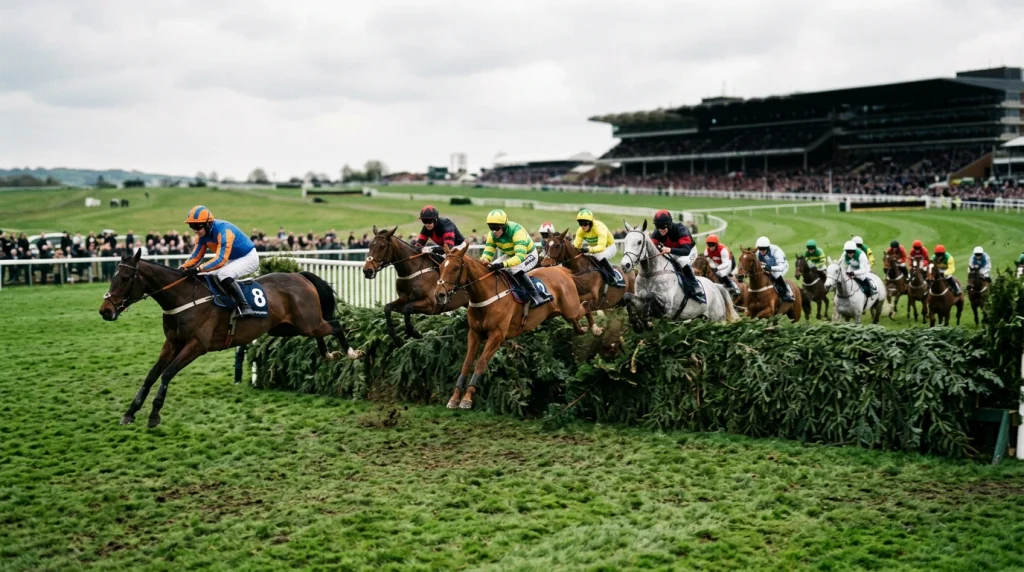
Grand National Place Terms and Each-Way Value
Every April I get the same set of messages from friends who don’t otherwise bet: “what should I do for the National?” The honest answer, which most of them don’t want, is: not what you’d do in any other race. The Grand National is a 30-fence chase over four and a quarter miles with up to forty runners, of which roughly half typically finish, and the favourite has won it once in the last decade. Treating it like a normal race — backing the well-fancied 6/1 chance to win, sticking the stake on the nose — is roughly the worst possible approach to the worst possible race for that approach.
What does work is each-way, often on horses priced 16/1 to 50/1, taken at enhanced place terms with one of the bookmakers running a promotion for the meeting. The mechanics of why this works are specific to Aintree, specific to the National, and specific to how the bookmaker pricing structure interacts with a race where the unpredictability is exactly the product they’re selling.
The Aintree favourite paradox
The data is brutal and unambiguous. Across the last decade of Grand Nationals, exactly one favourite has won the race — Tiger Roll in 2019, who was also defending his title from 2018. The favourite-strike rate is around 10%, against a UK average closer to 30-35% across all races. The horse the market has decided is most likely to win has, in practice, been an outsider against the field nine years out of ten.
The reasons are structural. Forty runners is too many for the form book to handle reliably. The Aintree fences are different in character from any other UK course — they punish jumping errors more than other tracks, and they punish them at full racing pace over four miles. The race is too long for many proven Grade 1 chasers, whose stamina trumps speed but not by enough to cover the trip. And the field includes a long tail of stayers who get into the National precisely because they can’t compete at a higher class — exactly the kind of horse who can stay the trip when better animals can’t.
What this means for the betting market: the favourite is priced as if his win probability is roughly 15-20% (depending on the year), and the underlying win probability is closer to 10%. Backing the favourite to win is a structurally losing trade. Even with BOG and best-price shopping, the favourite is the wrong end of the market for serious money.
The interesting question is where the value lives. If the favourite is overpriced, somebody in the field is underpriced. The pattern across decades is that the value lives in horses priced 16/1 to 33/1 who have a credible staying profile, a competent jumper’s history, and a trainer who has prepared specifically for Aintree. Those horses don’t win every year. They place at a rate that the place market has not fully absorbed.
Place terms at Aintree
The standard place terms for a 40-runner race are four places at one-quarter the odds. For the Grand National specifically, most bookmakers offer enhanced terms — five places, sometimes six, occasionally seven — at one-quarter or one-fifth the odds depending on the operator. The variation in place terms between operators is bigger on National day than on any other race in the calendar.
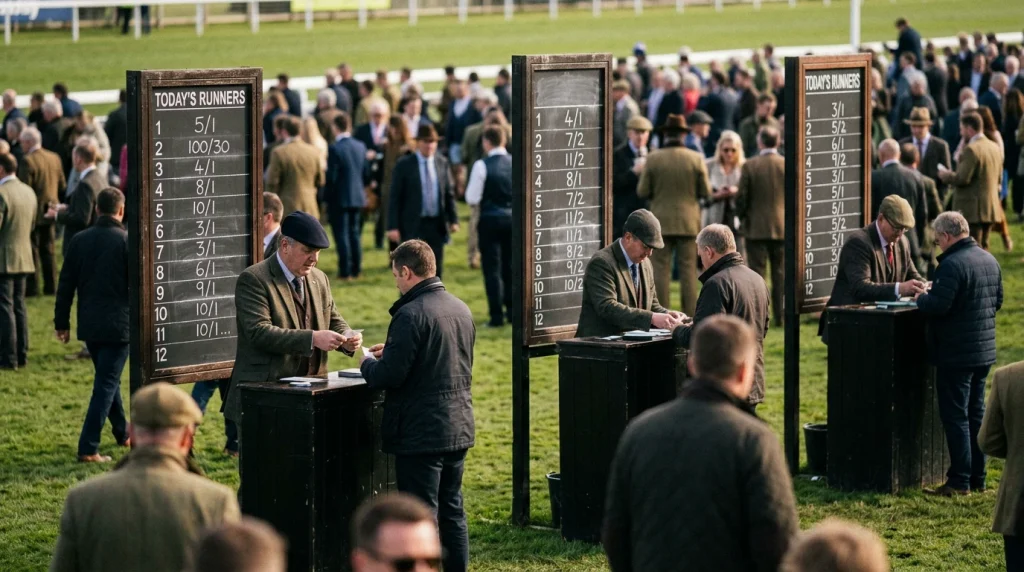
The arithmetic of an enhanced place is significant. A horse priced 25/1 each-way at five places at one-quarter pays 25/4 — about 5.25 in decimal — for any placed finish. Among forty runners competing for five place positions, the implied probability is 1/6.25 = 16%. The horse needs roughly a 16% chance of finishing in the top five for the place half to break even. For a stayer with a credible Aintree profile, that probability is plausible — and the place pool is wide enough that horses can place who wouldn’t be in the top ten in a Cheltenham field.
The other thing about Aintree place terms: the field size makes the bookmaker’s overround on the place market unusual. A 40-runner book is mathematically generous on the place positions almost by structural necessity. The bookmaker is trying to make money on the win market and offering attractive place terms to attract turnover. The maths can shake out in the punter’s favour if the right horse is selected at the right price.
Among UK punters who bet at scale — the 22% of racing fans who stake £100 or more per month — the National is the one race of the year where genuinely casual one-off bettors meet experienced staying-chase analysts in the same market. That dynamic widens the price range and creates pockets of value that don’t exist on quieter cards.
Building a shortlist of eight
The shortlist approach works because no single horse is going to win the National enough of the time to make a win-only strategy mathematically sound. Backing eight horses each-way in a 40-runner field with five places paid means you have eight darts thrown at five targets, where each dart costs both the win stake (probably lost) and the place stake (potentially won at the place fraction).
The criteria for the shortlist, in rough order of importance. First, proven staying ability over three miles or more in graded company — anything that hasn’t run convincingly over the trip is a guess regardless of how attractive the price looks. Second, jumping competence in big-field chases — Aintree fences are different but a horse that has fallen or pulled up in big-field competitive chases is statistically more likely to do so again. Third, trainer preparation — yards that target the National (Henry de Bromhead, Lucinda Russell, the Mullins operation, others) prepare runners specifically for the race, and their horses typically perform better than the form book suggests. Fourth, the right age — National winners cluster in the 9-11 age range; very young or very old runners are usually the wrong shape for the race.
The shortlist also needs the right price distribution. Eight runners at average 20/1 each-way costs 16 betting units, so you need to win back at least 16 units across the eight horses to break even. A single place at five places at one-quarter on a 25/1 horse returns 5.25 units on the place half plus the recovered stake. Two places across the eight shortlist would typically cover the cost; three or more would generate clear profit. The historic pattern suggests two-to-three places per year from a well-selected shortlist of eight, on average across many years.
What I avoid: market leaders priced shorter than 10/1. The headline favourite is structurally overpriced, and the second favourite usually inherits some of that distortion. Shortlist starts at 12/1 or longer in most years, with the bulk of selections in the 20/1 to 40/1 range.
Bankroll rule for one race a year
The Grand National is the one race where I’d recommend setting aside a dedicated bankroll specifically for it, separated from your usual betting funds. The reason is psychological as much as mathematical. The race attracts so much attention, so much sweepstake culture, so much “this is my one bet of the year” energy that the temptation to size positions emotionally is overwhelming.
My personal structure for the National bankroll: 1-3% of my annual betting budget, divided across the shortlist with each horse getting an equal each-way stake. If I’m betting £100 total for the race and have eight horses shortlisted, that’s £12.50 each-way per horse — £6.25 win plus £6.25 place. The total of £100 is the maximum at risk, the structure is symmetrical, and I am not tempted to weight toward favourites or against outsiders within the shortlist.
What I do not do is bet more “because it’s the National.” The race rewards discipline as much as any other, and the temptation to stake bigger because the event is big is the same temptation that bankrupts punters in casinos. The race lasts ten minutes once a year. The position size should reflect the risk, not the spectacle.
For casual punters who only bet the National and don’t otherwise wager, the same logic applies in proportion. Whatever you’d normally spend on a “fun” annual gambling decision is the cap. The race is genuinely enjoyable to watch with money on it, and genuinely miserable to watch with too much money on it. Pick the amount that adds to the enjoyment rather than subtracting from it.
Aintree place boost offers
Most major UK operators run place boosts specifically for the Grand National, layered on top of their year-round each-way structure. The standard offer is one or two extra places — five places where four would normally apply, or six places on a horse where five would be the default. The terms typically apply only to the National itself, not to the supporting card, and only to the win-and-place each-way product specifically.
The genuine value of these promotions depends on the specific race shape. In a year where the National field is unusually competitive and the place positions are likely to be distributed across many horses, an extra place is materially valuable. In a year where the form suggests a tight top end of the market, the extra place is less valuable because the placed positions are likely to be clustered among well-fancied runners who would have placed anyway.
The casual punter’s instinct is to take the maximum places on offer, and that instinct is broadly correct for the National specifically — the field size and unpredictability make the extra places useful most years. Where the instinct fails is in comparing across operators. The operator offering six places at one-fifth is not always better than the operator offering five places at one-quarter, because the fraction matters as much as the number of places. Run the maths for each offer on your shortlist price before deciding which operator to use. For the general mechanics of each-way and place fractions across UK racing, see my piece on each-way betting in UK horse racing.
FAQ
Treating the National as a different kind of bet
The Grand National is the one race of the year where the dominant strategy isn’t picking a winner. It’s structuring a portfolio of outsiders that can hit the wide place pool that the field size creates. Eight horses each-way at enhanced terms is a defensible approach in most years. A single bet on the favourite to win is a structurally losing approach in almost every year. The trick is to accept that this race plays by its own rules, treat it accordingly, and enjoy the fact that the one annual race where most punters lose the most is also the one where a disciplined each-way shortlist quietly stands a chance.
Articles and Strategies


Written by the editors at FurlongLab.
