
UK Horse Racing Overround and Bookmaker Margins
 Available in US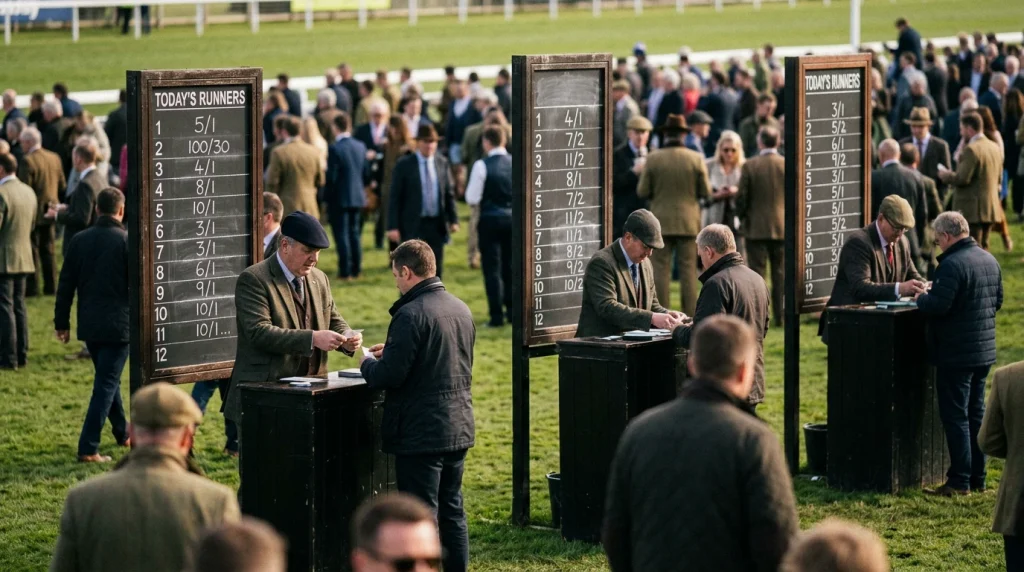
Calculating Bookmaker Overround and Margins
Ask the average Saturday punter what the overround was on the 3.10 at Doncaster and you will get a blank stare. Ask them what the favourite paid and they will give you the price to two decimal places. That gap — between knowing your price and knowing the margin you are being charged to take it — is one of the single biggest reasons most punters lose money over a season. The price is what you see. The overround is what you pay.
Race Advisor’s editorial line on long-run value puts it bluntly: “There is an absolute guarantee that if you are backing horses regardless of the price you will lose money in the long run.” That is the whole argument for understanding overround in one sentence. Every market is engineered with a built-in cost, and a punter who does not know how to read that cost is paying it forever without ever quantifying it. This piece walks through what overround actually is, how to calculate it in under a minute, what range you should expect on UK racing markets, how it relates to Betfair Exchange margins, and how to use the number to screen races you should not bet at all.
What a 100% Book Would Actually Look Like
A fair book is a market where the implied probabilities of every horse winning add up to exactly 100%. If a four-horse race had each horse at 4/1 (decimal 5.0), the implied probability of each would be 20% — total 80%, which is well under a fair book. If each horse were priced at 3/1 (decimal 4.0), the implied probability would be 25% each — total 100%, a perfectly fair book that no commercial bookmaker would ever offer.
The reason a real-world book is always more than 100% is that the bookmaker is in business. The excess over 100% is the bookmaker’s edge — the price you pay to play the market. If a four-horse race had each horse at 2/1 (decimal 3.0), the implied probability would be 33.3% each — total 133.3%. That is a 33.3-point overround, which would be aggressive even by sharp shop standards. In practice, UK racing markets sit between 105% and 130%, with twelve-runner Saturday handicaps clustering around 115% to 125%.
The conceptual point is that no one pays the overround in a single transaction — it is paid in aggregate over many bets. You can absolutely win individual bets at any overround. What you cannot do is win in the long run at an overround so high that the structural cost erodes any edge you bring. Knowing your overround number is the first step to knowing whether value is theoretically available in the market at all.
Calculating Overround in Under a Minute
The calculation itself is school arithmetic, and once you have done it five times you can run it on a race in less than a minute. Take each horse’s decimal odds. Calculate 1 divided by those odds — that gives you the implied probability as a decimal. Add up all the implied probabilities. Multiply by 100. That number is your book percentage.
Worked example: a six-runner race priced at 2.0, 4.5, 6.0, 9.0, 12.0, 21.0. The implied probabilities are 0.500, 0.222, 0.167, 0.111, 0.083, 0.048. Add them up: 1.131. Multiply by 100: 113.1%. That is a 13.1-point overround, which is reasonable for a six-runner field on a Tuesday afternoon. If the same race had been priced 1.8, 4.0, 5.5, 8.0, 11.0, 17.0, the calculation would be 0.556 + 0.250 + 0.182 + 0.125 + 0.091 + 0.059 = 1.263, or 126.3% — a 26.3-point overround, which is aggressive and signals that value is going to be hard to find.
The angle this opens is comparing the same race across multiple firms. If firm A is showing 113% on a race and firm B is showing 119%, the same set of horses will be priced more generously somewhere across firm A’s board. The Race Advisor warning about long-run loss applies most painfully to punters who bet exclusively at the firm with the worst book on every race. Even before you analyse a single horse, an account that consistently offers a lower overround across the same races is structurally cheaper to play. Reference points worth keeping in mind: the UK remote betting market accounted for around £766.7 million in gross gambling yield on horse racing in the most recent reporting period — and a meaningful slice of that revenue is the overround paid by punters who never measured it. The second favourite across UK handicaps shows a strike rate of around 19.4% with a long-run ROI of −11.8% at SP, a real-world demonstration of how a structural overround erodes returns when the price is taken without comparison.
What Typical UK Overrounds Actually Look Like
Knowing the typical range is what lets you recognise an outlier. Across UK racing, the overround on a competitive twelve-runner Saturday handicap usually sits between 115% and 125%. A six-runner Class 2 race on a Saturday will tighten to around 108% to 115% because field size compresses the margin per horse. A twenty-runner Grand National-style handicap can balloon to 140% or beyond, because the bookmaker is spreading risk across so many outsiders.
Tuesday afternoon meetings at minor venues tend to run slightly wider books than Saturday meetings at major courses — between 118% and 128% as a typical range — because the market is less liquid and the bookmaker compensates by widening the margin. Festival races and major handicaps run tighter books because public attention drives competitive pricing among the major firms.
The number to watch for is the outlier in either direction. A 105% book on a competitive twelve-runner handicap is unusually tight and probably reflects a firm that has been hit hard on one runner and is trying to attract action elsewhere. A 132% book on a six-runner novice race is unusually wide and signals a firm uncomfortable with the data. Both are useful information, but neither is a licence to bet without doing the underlying value work first.
Overround vs Betfair Exchange Margins
The exchange model — Betfair, Smarkets — does not run an overround in the traditional sense. The exchange matches back and lay orders against each other, and the margin comes from a commission on net winnings rather than a built-in markup on every price. Typical commission on Betfair is around 5%, charged on the net win per market.
The way to compare a bookmaker price to a Betfair lay price is to deduct the commission from the implied Betfair return. If you would back at Betfair lay of 5.0 and the firm is offering 4.6, your effective Betfair return after commission is around 4.8, which still beats the firm’s offer. If the firm matches 4.8 with Best Odds Guaranteed and the Betfair lay shortens before the off, the firm might end up the better play. The calculation matters race by race.
The wider implication is that overround as a single number underestimates the bookmaker margin once you factor in the value of Best Odds Guaranteed and the cost of restrictive limits at sharp accounts. Betfair commission is transparent. The bookmaker overround is partly transparent and partly hidden. The structural cost of betting with a single firm at unfavourable books, taken across a year of action, can be the difference between break-even and a clear winning record. The detail on how the overround calculation feeds into a broader value framework sits in my piece on the value betting UK horse racing system, which walks through the maths of edge calculation across multiple firms.
Using Overround to Screen Races You Should Not Bet
The most practical use of overround is as a screening tool. Before I start analysing the horses, I calculate the book percentage on the race. If the overround exceeds 125% on a twelve-runner handicap, or 120% on a six-runner non-handicap, I treat the race as marginally bet-worthy. If the overround exceeds 130%, I usually skip the race entirely unless I have an unusually strong specific read.
The reasoning is mathematical. At a 130% book, the average bet returns roughly 77p in the pound just from the structural cost. Even a strong value read on a single horse needs to produce a substantial edge to overcome that headwind. At 115%, the same edge produces a meaningfully better long-run return. Choosing which races to bet at all — based on the overround alone — is one of the highest-leverage filters in a Saturday workflow.
The exception is when the overround is wide because a single horse is heavily backed in the morning and the firm has compressed his price aggressively. That can create value in the rest of the book, especially the second and third favourites whose prices have been padded to make room for the move. Reading the structural overround alongside the price movements during the morning gives you a fuller picture than either piece on its own.
Treating the Book Percentage as a Daily Habit
Calculating the book percentage on every race I plan to bet has become as automatic as checking the going. It takes thirty to sixty seconds, it costs nothing, and it provides a single number that tells me whether the structural cost of the market is reasonable before I commit any thinking time to picking a horse. The punters who do this consistently are the punters who survive the years that catch out the ones who do not. The number is not a value indicator on its own — but it is the fence at the edge of the cliff. Knowing where the fence is is the first piece of work, and everything else builds on it.
Articles and Strategies

Published by the FurlongLab team.
