
All-Weather Racing Systems in the UK
 Available in US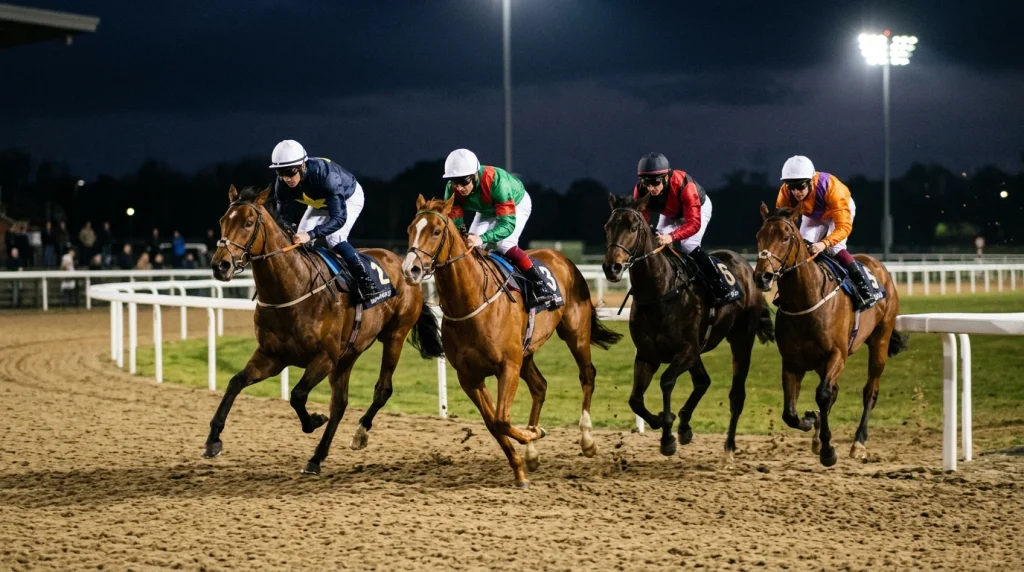
Polytrack and Tapeta Strategies for All-Weather Racing
The first January I bet seriously, I lost a slow, painful five hundred pounds on all-weather meetings before I understood what I was looking at. I had spent the summer building a flat model that worked nicely on turf at Newmarket and Goodwood, and I assumed the same inputs would translate. They did not. Synthetic surfaces are not turf without grass — they are their own discipline, with their own biases, their own repeat runners, their own pace patterns, and their own trainers who have made a career out of knowing how to win on them.
This piece is the system I built after that expensive winter, refined over ten subsequent ones. The six all-weather circuits in the UK each have a distinct personality, and a punter who treats Lingfield’s Polytrack the same as Newcastle’s Tapeta is going to lose money on at least one of them. The next sections walk through the six tracks, the differences between the surfaces, the pace patterns I have learned to bet into, and how to build a small set of filters that holds together across a winter.
The Six UK All-Weather Tracks and What Makes Each Different
Lingfield, Kempton, Wolverhampton, Newcastle, Chelmsford and Southwell are the six tracks running synthetic flat racing in the UK. They share the basic premise — flat racing on an artificial surface, run year-round but most heavily through the winter — but they diverge in almost every other respect.
Lingfield runs Polytrack on a tight, left-handed circuit with a sharp final bend. Front-runners with a low draw in sprints have a structural advantage there, and the bias is well documented enough that bookmakers price it in. Kempton runs Polytrack on a flat, oval circuit with two distinct chutes — Lingfield rewards positioning, Kempton rewards pace. Wolverhampton runs Tapeta on a tight, left-handed bend with a tighter run-in than most expect. Newcastle is the longest UK all-weather mile, also Tapeta, and the straight course there is the one place on the synthetic circuit where the conditions most closely resemble a summer flat mile. Chelmsford runs Polytrack on a sharp left-handed circuit and is a venue where local form patterns matter more than they should. Southwell, after switching from Fibresand to Tapeta, has become an entirely different track from the one it was five years ago — older form books are unreliable for the current configuration.
The reference point I keep in my head is the UK favourites strike rate baseline. Across all UK racing, favourites win between thirty and thirty-five per cent of races. On the all-weather, that figure varies sharply by track. Lingfield and Kempton tend to track the national baseline closely. Wolverhampton and Chelmsford run a touch above, because tight circuits favour the well-fancied. Newcastle and Southwell on Tapeta surfaces produce more variance, because the surface kicks back differently and front-runners who go off too fast tend to fade. Knowing where each track sits relative to that baseline is the first thing I check before I start looking at a card.
Polytrack vs Tapeta — More Than a Material Difference
Polytrack and Tapeta are both synthetic mixes designed to provide consistent footing in any weather, but the experience for the horse is different. Polytrack has a softer, more cushioned feel — horses tend to settle into a rhythm and the surface forgives small errors. Tapeta is firmer and quicker, with a sharper kickback that can affect horses running close to the inside.
The practical betting consequence is that surface preference matters. Some horses run consistently better on one surface than the other, and that preference is more stable than going preference on turf. If a horse has run six times on Polytrack and never finished worse than fourth, then twice on Tapeta and finished tenth both times, you have information that the market routinely misprices. I keep a column for surface form in my pre-race notes for any horse that has run on more than one synthetic surface.
The bigger trap is treating “all-weather form” as a single category. A horse with form figures of 21321 on Polytrack and a single 14th on Tapeta does not have all-weather form of “21321/14” — it has Polytrack form of 21321 and a single bad Tapeta run that tells you nothing. The Racing Post does not always make the distinction clearly, and the bookmakers’ algorithms often do not either, which is exactly why the angle pays.
The Pace Bias That Decides Most All-Weather Sprints
Pace dominates all-weather sprints in a way it rarely does on turf. The tight circuits, the consistent surfaces and the smaller fields combine to give front-runners a structural advantage. On Lingfield’s six furlongs, a confirmed front-runner from a low draw is the structural favourite even before the form figures are factored in. On Wolverhampton’s five and six furlongs, the same dynamic applies. The pace map is the single most valuable piece of pre-race information you can build for all-weather sprints.
The way I build a pace map is straightforward. I look at the last three runs of each horse and code the run style — front-runner, prominent, mid-division, hold-up. I then look at the draw — on tight circuits, inside draws benefit front-runners disproportionately. If there is only one confirmed front-runner in a six-furlong Lingfield sprint and he draws stall two, that is a horse that needs to be in your shortlist regardless of form figures. The market often does not price this correctly because the form column shows recent defeats from outside draws or against multiple pace rivals.
The reverse situation is just as exploitable. Three confirmed front-runners in the same race almost guarantees a fast early pace, which sets up the closers. In that scenario, I downgrade the front-runners and upgrade any horse with a hold-up style and a recent run that shows it stayed the trip. These are the spots where a 20/1 horse can finish second at a price the market never offered before the off, because nobody priced in the pace setup.
Repeat Runners and the Recency Effect
All-weather horses run more often than turf horses. Recovery is quicker, the surfaces are more forgiving, and the calendar runs through winter when there is little competition for fixtures. A horse running every two weeks through November and December is normal on all-weather; on turf in spring, that same horse would be considered over-raced.
This creates a recency pattern I bet into. A horse coming off a recent win at the same track, against similar grade and at the same trip, is a more reliable proposition on all-weather than on turf because the conditions are stable. The horse that won at Chelmsford over a mile on Polytrack ten days ago is genuinely likely to run within a length of that effort if it returns to the same track, same surface, same trip. On turf, ten days between runs in changing going introduces too many variables. On all-weather, you are largely betting the same race twice.
The discipline I keep is to require at least three runs at the surface before I trust the pattern. A single win on Polytrack from a horse with thirty turf runs is not a Polytrack horse — it is a horse that won once on Polytrack. Three runs at the surface, two of them competitive, gives you a real read on whether the horse genuinely prefers the medium.
The System Filters That Actually Hold Through Winter
The filters I run on every all-weather card are: surface specialism, trainer all-weather strike rate (separately tracked from turf SR), draw and pace setup, and class-grade level. Notice what is not on that list — going, market position outside the top five, and trainer “form” over the last fortnight. The first I have learned to ignore on synthetic surfaces, and the second two are noise more often than signal.
The number I anchor on is that, across the UK racing landscape, forty-three of every forty-eight competitive race winners come from the top five in the market. That holds for all-weather as much as for turf. If my filters point me outside the top five of the market, I had better have a very specific reason — a clear pace edge that explains the price, an obvious surface preference, a yard that targets this exact race grade. Without one of those, I leave the speculative outsider to someone else.
The winters where I have followed these filters strictly have been profitable, in a quiet, low-variance way. The winters where I have got bored, bet down the card, and chased outsiders to “make the meeting interesting” have been losing winters. All-weather rewards patience more than almost any other code in the UK calendar — partly because the fields are smaller, partly because the surfaces are stable, and mostly because the punters who lose at all-weather are the ones who confuse boredom with opportunity. If you want the wider context for how I split my year between codes, my piece on jumps vs flat racing strategy walks through how all-weather slots between them and where the calendar phasing matters most.
Reading the Six Tracks as Six Sports
The single biggest improvement I made to my all-weather profit was the moment I stopped treating the six tracks as one category. Lingfield is a sport. Kempton is a sport. Newcastle, Wolverhampton, Chelmsford and Southwell are each their own sport. A horse with three good runs at Lingfield has Lingfield form, not all-weather form, and you should bet it accordingly. The bookmakers have caught up to “all-weather form” as a category, but they still misprice track-specific records often enough to make the work worth doing. Build six small files, one per track, refresh them every quarter, and you have a winter operation that the rest of the betting public is too lazy to replicate.
Articles and Strategies



Created by the "FurlongLab" editorial team.
