
In-Play Betting on UK Horse Racing Markets
 Available in US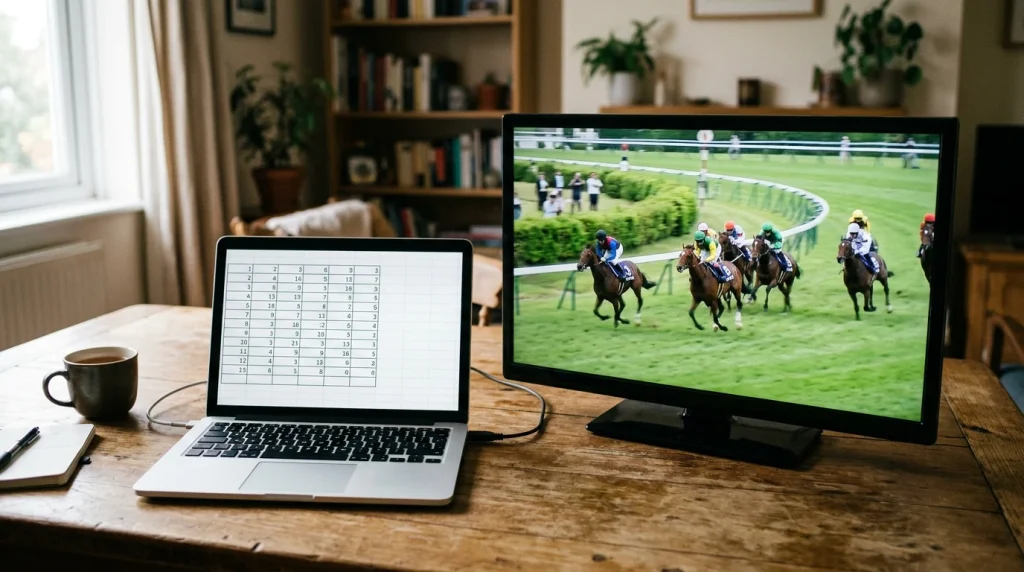
Navigating Liquidity and Delays in In-Play Betting
The first in-running bet I matched, I matched on my phone at a friend’s barbecue in 2015, watching the picture on a small screen lag visibly behind the radio commentary I had running through headphones. I got £20 matched at a price that was already eight ticks shorter than I’d seen on the screen. That was the moment I learned, viscerally, that in-play horse racing isn’t a market — it’s a race between you, the betting platform, and everyone else with a faster picture than yours. The participants with the fastest information win. The rest are decoration.
In-play horse racing markets are where the largest amounts of money move in the shortest amounts of time on Betfair Exchange. The prices shift every second of the race, the unmatched orders cascade through the book, and the punter watching a delayed broadcast is essentially trading against punters who already know which horse is in the lead. This isn’t a complaint — it’s the structural reality of the market, and any in-play strategy that doesn’t price the picture-delay problem is a strategy that will lose money systematically.
How in-play markets form
The in-play market opens at the off and closes at the line, with the price of every runner updating continuously as the race unfolds. The mechanism is the same matched-order system that runs Betfair pre-race, but the speed and volume in-running are an order of magnitude greater. A heavily-traded UK Saturday handicap might match £200,000 pre-race and £600,000 in-running, with most of the in-running volume concentrated in the middle two minutes of a five-minute race.
The prices respond to two things: the position of each horse in the race and the betting flow itself. The position drives the price because punters are watching the race and adjusting their stakes — the leader’s price shortens, the back-marker’s price drifts. The betting flow drives the price independently because traders are taking positions ahead of the pace, sometimes correctly and sometimes not, and their orders move the matched price even when the race itself hasn’t changed.
The two forces sometimes pull against each other. A horse can be in the lead with its price drifting because traders are anticipating that it will not stay the trip. The matched market is processing what the trading community thinks will happen, not just what is happening. That’s why in-play prices contain genuine information beyond the picture alone — and why the gap between the picture and the price is where the edge actually lives.
Betfair holds roughly 22% of the global online horse racing betting market, and the bulk of that share lives in UK racing in-running markets specifically. The depth of the in-running book on a Premier Saturday card is the deepest market in any racing platform globally. That depth is what makes serious in-play strategy possible — without the matched volume, the bid-ask spread would be too wide to extract anything but the largest mispricings.
Picture delay versus data feed
This is the single most important thing to understand about in-play horse racing. The picture you see on your TV or laptop is delayed relative to the actual race by anywhere from 3 to 12 seconds, depending on the broadcaster and your distribution path. Sky Sports Racing, ITV Racing, Racing TV, the various streaming services — each has its own latency, and none of them are the same as the data feed that professional traders use.
The data feed is the wire from the racecourse itself, sometimes augmented by tracking sensors on the horses and the riders, sometimes derived from a faster camera with image processing. The latency is sub-second. Professional in-running traders watch the data, not the picture, because the picture is essentially historical by the time it reaches a home viewer.
The implication for retail punters is uncomfortable. Trading in-play against the picture means trading against people who already know what’s about to happen on your screen. The horse you see hitting the front has, in the data feed, already been overtaken by another horse — and the prices have already moved to reflect that, three to twelve seconds before your picture catches up.
The technology infrastructure is closing the gap, partially. Betfair UK’s predictive AI pricing system cut internal settlement latency by 28% in 2025, which means the matched prices reach the user interface faster — but the picture-versus-data gap is a different problem. The picture comes from a broadcaster; the data comes from the track. Fixing one doesn’t fix the other.
What this means for someone considering in-play trading: either get a data feed, or accept that the picture-trade will lose money over time. Race Advisor put the broader principle bluntly: “There is an absolute guarantee that if you are backing horses regardless of the price you will lose money in the long run.” The in-play version of that principle is: backing horses in-running against a delayed picture is a guaranteed long-run loss because you’re trading on information that’s already in the price.
Liquidity windows in-running
The liquidity in an in-running market is not constant. It builds in the early part of the race as the field gets set, peaks in the middle phase as the race shape becomes clearer, and either consolidates or dissipates in the closing furlong depending on whether the result looks decided or contested. Knowing when the liquidity is there is half of in-play trading.
For a typical 5-furlong sprint, the liquidity is fast-forming and fast-departing — the entire window is sixty seconds, and the matched price is essentially flat for most of it because the race shape is set early. The opportunities in sprints are pre-race set-up errors that resolve in the first ten seconds, not in-running trading per se.
For a mile-and-a-half flat handicap, the liquidity is fuller and the trading window longer. There are typically two phases — the early jostle as the field settles, and the closing third where the speed-figures pace against the bidders. Most of the matched volume goes in the second phase, when the result is becoming clearer but not yet certain.
For a three-mile chase, the windows are larger again. The race lasts six minutes, and the matched market can effectively reset two or three times — fallers, pace changes, gaps opening up between groups of runners. Each reset is a window where prices move sharply and matched volume spikes. The risk is also higher, because the race is longer and more unpredictable.
A practical rule: liquidity windows correlate with race phases the picture audience finds dramatic. Big jumps, sharp turns, sudden changes of pace — these are the moments the matched volume peaks and the spreads widen, because the in-running traders are taking positions on whether the dramatic moment is real or transient.
Back-to-lay during the race
The classic in-running strategy is back-to-lay: back a horse pre-race at a longer price, lay it during the race at a shorter price, and lock in profit regardless of the result. The trade works because horses in the lead of a race shorten dramatically in the in-running market — sometimes from 6/1 pre-race to 6/4 in-running with a furlong to go.
The mechanics: you’ve backed the horse at decimal 7.0 with £100, so your liability if it loses is £100, and your return if it wins is £700. The horse takes the lead with two furlongs to go and trades at decimal 2.0 in-running. You lay it at decimal 2.0 for £200, which means you’ve taken £200 of liability on the lay side. If the horse wins, you collect £700 from the back and lose £200 on the lay — net £500. If the horse loses, you lose £100 on the back and collect £200 on the lay — net £100. Either way, you profit.
The trade looks free on paper. In practice, the price you can actually lay at when the horse is in the lead depends on the picture-versus-data gap, the matched depth at the lay price you want, and whether other traders have got there first. The £200 lay at 2.0 might match at 1.8 because the price moved while you were placing the order. The locked-in profit shrinks accordingly. Sometimes it shrinks to nothing.
The trade also looks scalable. In practice, the lay liquidity at short in-running prices is the deepest part of the market — punters who pre-backed the horse are themselves trying to lay out, and the resulting traffic compresses the matched price quickly. The window of actually executable back-to-lay opportunities is narrower than the headline arithmetic suggests. For a deeper walk-through of how lay-side strategy works systematically, see my piece on lay betting on UK horse racing on Betfair Exchange.
Bot execution in-running
The next layer up is bot-driven execution, which is where most of the serious in-running volume now sits. A bot watches the data feed, identifies pre-defined trading patterns, and executes orders without human intervention. The patterns can be back-to-lay automation, in-running lay-the-favourite triggered by pace data, ladder-trading on price movements, or any of a dozen other strategies.
The reason bots dominate is execution speed. A human watching the picture cannot place an order faster than the matched price has already moved away from where they wanted to place it. A bot watching the data can place orders within milliseconds of the conditions triggering. The matched market is, structurally, a market between bots and the slower participants who feed them.
For retail punters, the bot ecosystem matters because it sets the floor on what kinds of strategies are viable. Strategies that require fast execution against changing prices are not viable for a manual trader. Strategies that work on slower signals — pre-race positioning, post-race CLV measurement, value picking — remain viable. The right approach for a retail in-play participant is to specialise where the bots have less advantage rather than competing where they have all the advantage.
FAQ
In-play as a specialist game, not a default strategy
In-running horse racing trading is a real market with real edge available, but the edge is structural — it lives with the participants who have the data feed, the execution speed and the discipline to specialise. For the retail punter, in-play is a tool to use selectively rather than a default home for activity. Pre-race positioning combined with selective in-running hedges remains a defensible approach; pure reactive in-running trading against a delayed picture is not. Pick the side of the speed gap you want to be on, and structure your participation accordingly.
Articles and Strategies



Created by the "FurlongLab" editorial team.
